

Best AI Tools for Passive Income in 2026
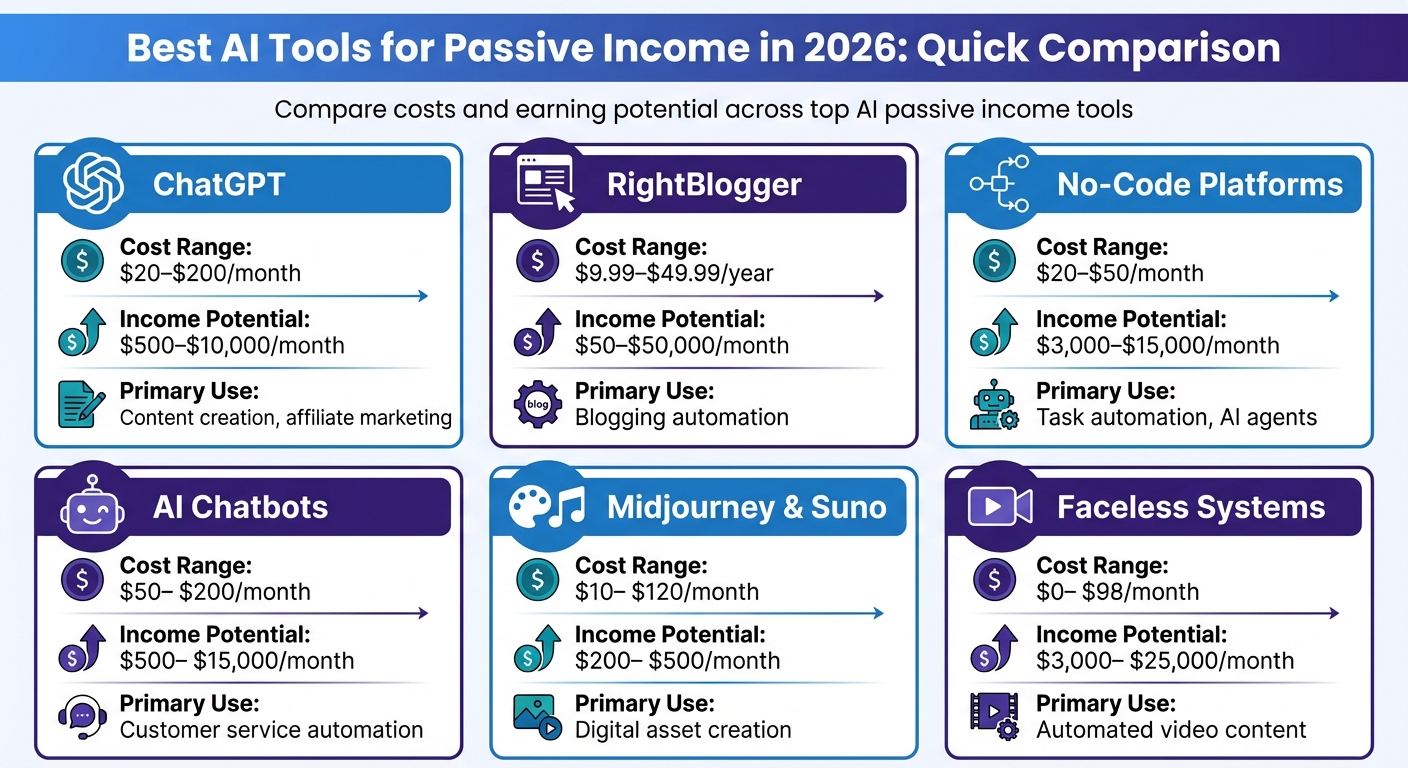
AI tools have made generating passive income easier than ever in 2026. Whether you’re creating digital products, automating content, or building custom solutions for businesses, these tools reduce effort and costs while opening up new income opportunities. Here’s a quick breakdown of the top tools and their potential:
- ChatGPT: Automates content creation, customer support, and affiliate marketing with plans starting at $20/month. Potential earnings: $500–$10,000/month.
- RightBlogger: Focused on blogging automation with unlimited content creation for as low as $9.99/year. Perfect for affiliate marketing and niche sites.
- No-Code Platforms: Tools like Zapier and n8n simplify task automation and app creation. Developers can earn $3,000–$15,000/month by creating AI agents for local businesses.
- AI Chatbots: Custom bots for businesses handle customer service and lead qualification. Earnings range from $500–$1,500 per bot, with ongoing maintenance income.
- Midjourney & Suno: Create digital visuals or music for products, stock libraries, or licensing. Passive income potential: $200–$500/month or more.
- Faceless YouTube/TikTok Systems: Automate video creation using AI for scripting, voiceovers, and visuals. Channels can earn $3,000–$25,000/month through ads, sponsorships, and product sales.
These tools cater to beginners and experienced creators alike, offering scalable ways to generate income. Whether you’re selling templates, automating workflows, or producing faceless content, AI makes it possible to build multiple income streams with minimal ongoing effort.
Quick Comparison
| Tool | Cost Range | Income Potential | Primary Use |
|---|---|---|---|
| ChatGPT | $20–$200/month | $500–$10,000/month | Content creation, affiliate marketing |
| RightBlogger | $9.99–$49.99/year | $50–$50,000/month | Blogging automation |
| No-Code Platforms | $20–$50/month | $3,000–$15,000/month | Task automation, AI agents |
| AI Chatbots | $50–$200/month | $500–$15,000/month | Customer service automation |
| Midjourney & Suno | $10–$120/month | $200–$500/month | Digital asset creation |
| Faceless Systems | $0–$98/month | $3,000–$25,000/month | Automated video content |
AI tools are reshaping how passive income is generated. Start small, pick a tool that fits your skills, and scale as you grow.
AI Tools for Passive Income: Cost vs Earnings Comparison 2026
5 AI Passive Income Ideas – How To Make $37k per Week
1. ChatGPT
ChatGPT plays a central role in automating passive income streams by handling tasks like content creation and customer support. Its pricing is straightforward, starting with a free tier, moving up to a $20/month Plus plan that includes features like Sora video generation, custom GPTs, and the Codex agent. For those needing more, the $200/month Pro plan offers unlimited messages and advanced reasoning capabilities.
Key Features and Automation Capabilities
One of ChatGPT’s strengths is how seamlessly it fits into your workflow. With Custom Instructions, you can lock in your brand voice to ensure consistent content across all outputs. It also supports prompt chaining, allowing you to create structured, section-by-section content. For example, ChatGPT can automate an entire blog pipeline, generating over 30 SEO-optimized articles per month with minimal input. Connect it to automation tools like Zapier or Make.com, and it can handle social media posts, email sequences, and even customer inquiries.
Passive Income Potential
How much you earn depends on your strategy. Selling digital products like eBooks or templates can bring in $50–$5,000 monthly. Affiliate marketing content has the potential to generate $500–$10,000 or more. Meanwhile, established YouTube automation channels using ChatGPT for scripting often earn between $1,000 and $10,000 per month. Many creators maximize their income by combining multiple streams rather than relying on just one.
Scalability and Long-Term Use
ChatGPT’s tiered plans are designed to grow with your business. The Business plan, at $25 per user per month, offers secure workspaces and access to over 60 app integrations. For larger needs, the Enterprise plan includes expanded context windows (up to 128K) and priority support. Both Pro and Business tiers come with features like agent mode and deep research tools, helping users stay competitive as AI-generated content becomes increasingly common. These plans also safeguard your proprietary data by ensuring it isn’t used for model training.
Next, we’ll dive into another AI tool that’s reshaping passive income strategies.
2. RightBlogger

RightBlogger streamlines the content creation process for bloggers with automation tools designed to save time and boost productivity. It offers a free tier with 2,000 words per month, while its paid plans – Lite ($9.99/year), Pro ($29.99/year), and Business ($49.99/year) – provide unlimited word counts. This means you can produce as much content as you need without worrying about hitting a cap.
Key Features and Automation Capabilities
RightBlogger’s Autoblogging feature takes care of the entire blogging process, from keyword research to publishing. It can automatically schedule and post content to platforms like WordPress, Ghost, and Webflow. If you’re active on YouTube, the platform’s YouTube-to-Blog automation turns your videos into SEO-optimized articles, helping you repurpose content and attract a new audience.
Other standout tools include MyTone, which learns your writing style to create content that feels personal and authentic, and Tool Studio, which allows you to build interactive tools like calculators or generators. These tools not only engage readers but can also help grow your email list passively.
"RightBlogger is the best AI writing tool for bloggers on the market today, out of the dozens I’ve tried."
– Sadie Smiley, Founder, Passive Income Pathways
Passive Income Potential
RightBlogger is tailored for bloggers looking to monetize their content. The Review Generator simplifies the creation of affiliate marketing posts, while the Keyword Cluster tool helps you develop detailed content strategies for niche websites. Co-founder Ryan Robinson has demonstrated the platform’s potential by earning over $50,000 per month through affiliate marketing and digital products – strategies that RightBlogger is specifically designed to support.
With the ability to generate content in 134 languages, the platform also opens the door to creating localized niche sites, allowing you to tap into international markets.
Scalability and Long-Term Use
RightBlogger is built for growth. Its MyTone feature can store up to five unique brand voices, making it perfect for managing multiple clients or niche sites simultaneously. The Knowledge feature retains critical business information, ensuring the AI delivers accurate and relevant content as your library grows.
With over 90 specialized tools and seamless publishing integrations, RightBlogger can handle large-scale content production without requiring additional subscriptions. Plus, the unlimited word count included in the Pro and Business plans ensures that your costs stay predictable, even if you’re producing hundreds of articles each month.
Next, we’ll dive into another AI tool reshaping how bloggers approach passive income strategies.
3. No-Code Platforms
No-code platforms bridge AI models with essential business tools, simplifying task automation and streamlining workflows seamlessly.
Cost and Pricing Plans
- Zapier: Plans start at $20/month (Starter) and $50/month (Professional), unlocking premium apps and multi-step automations.
- n8n: Offers a free self-hosted version for tech-savvy users, while its Cloud plan begins at $20/month for 5,000 executions and scales to $50/month for 25,000 executions.
- Building AI agents for local businesses typically costs between $50 and $200 per month, covering API access and specialized tools.
Key Features and Automation Capabilities
No-code platforms integrate thousands of apps via APIs, automating tasks such as social media posting, lead qualification, customer support responses, and even managing entire sales funnels – all without requiring daily supervision. For example, Systeme.io combines email marketing, sales funnels, and course creation in one platform, making it easier for solopreneurs to handle technical challenges.
AI-powered tools like Claude Code allow users to create mobile apps simply by describing their ideas – no programming skills needed.
"True passive income requires a functional detachment from the output process."
– Basit, Founder, TheBizAIHub
These capabilities open up new opportunities for generating passive income.
Passive Income Potential
No-code platforms make it possible to create multiple income streams. In January 2026, analyst Claudio Lupi reported earning $8,700 in a single month by building custom AI agents for local businesses like dentists and real estate agents. Each agent required about 4 hours to create and sold for $500 to $1,500.
Similarly, between 2024 and 2026, Etsy seller Emily McDermott generated over $200,000 in revenue by selling Excel and Google Sheet templates. These templates were created once and sold repeatedly, with the platform managing the sales process.
Other examples include print-on-demand sellers earning between $1,500 and $10,000 per month, and dropshippers bringing in an average of $41,000 annually.
Scalability and Long-Term Use
No-code platforms grow alongside your business. Zapier, with its 4.7/5 rating on G2, is celebrated as a leader in automation, while n8n scores 4.4/5 for its customization options and cost-efficiency. These tools allow you to manage multiple income streams by integrating calendars, content, and email systems, ensuring continuous operation.
For solopreneurs, incorporating AI and automation can boost productivity by up to 40%, effectively freeing up nearly two extra workdays each week.
To maximize scalability, focus on creating digital products like templates, planners, and eBooks, which can be sold repeatedly with minimal ongoing costs. You can also implement evergreen webinars with automated email follow-ups to generate consistent conversions without daily oversight.
4. AI Chatbots
AI chatbots are transforming how businesses handle customer service, lead qualification, and appointment scheduling. These bots are trained using specific business data – like FAQs, service lists, and pricing details – to deliver accurate and timely responses. This makes them particularly useful for local businesses such as dental offices, plumbing services, and real estate firms. One of their biggest advantages? They work around the clock, capturing leads and answering questions even while you’re asleep.
Cost and Pricing Plans
Creating custom AI chatbots comes with a range of costs. For API access and development tools, expect to pay between $50 and $200 per month. Local businesses typically spend $500 to $1,500 for a fully customized AI agent, with each agent taking about 4 hours to develop. Once the chatbot is up and running, ongoing management services generally cost between $100 and $500 per month, offering a hands-free solution for business owners.
Key Features and Automation Capabilities
Today’s AI chatbots can handle thousands of interactions per minute, seamlessly integrate with business calendars, and pre-qualify leads by filtering out unqualified prospects. This automation ensures only high-quality leads make it to a human representative. Tools like Botpress, Intercom Fin, and the OpenAI API allow developers to create functional prototypes in just 1 to 3 weeks. These features open up valuable opportunities for both developers and businesses to boost efficiency and revenue.
"I’m building custom AI agents for local businesses… Dentists, plumbers, real estate agents. They pay $500–1,500 per agent." – Claudio Lupi, Data Leader
Passive Income Potential
For developers, building AI chatbots for local businesses can be a lucrative venture. Monthly earnings typically range from $3,000 to $15,000, depending on the number of clients. For example, in January 2026, Claudio Lupi reported earning $8,700 in a single month from creating chatbots for service providers. Most developers secure their first client within 4 to 8 weeks of starting. With the AI market projected to hit $1.01 trillion by 2031, and 78% of companies already integrating AI into at least one area of their operations, the potential for growth is massive.
Scalability and Long-Term Use
AI chatbots are highly scalable, evolving from simple, single-purpose tools into comprehensive systems that manage critical business workflows. Long-term revenue often comes from charging monthly fees to maintain and update these bots. Additionally, integration tools like Zapier and n8n make it easy to connect AI chatbots with platforms like Gmail, Notion, or HubSpot. By focusing on niche solutions – such as AI-driven lead scoring for real estate – developers can command higher fees and build lasting income streams. This scalability cements AI chatbots as a key player in the growing landscape of automated business solutions.
sbb-itb-d544328
5. Midjourney and Suno
AI tools for content and customer automation have opened up new opportunities, and creative asset generation is proving to be a lucrative path. Platforms like Midjourney and Suno enable creators to produce digital assets – from visuals to music – without the overhead of traditional production costs. For instance, Midjourney generates an impressive $200 million in annual revenue, underscoring the growing demand for AI-driven visual content.
Cost and Pricing Plans
Midjourney offers four pricing tiers to suit different needs:
- Basic Plan: $10/month for 3.3 hours of GPU time.
- Standard Plan: $30/month for 15 hours of GPU time, plus unlimited "Relax Mode" for slower, unlimited image generation.
- Pro Plan: $60/month, which includes "Stealth Mode" for private image creation.
- Mega Plan: $120/month for 60 hours of GPU time and the fastest processing speeds.
The introduction of "Draft Mode" in Midjourney V7 has been a game-changer, allowing images to render 10x faster at half the cost. This feature is perfect for creators who need to quickly test and refine products. For those earning more than $1,000,000 USD annually, the Pro or Mega tiers are mandatory to retain commercial rights.
Key Features and Automation Capabilities
Midjourney includes tools like Character Reference (--cref) and Style Reference (--sref), which help creators maintain consistent branding across product lines or social media platforms. The --tile parameter is another standout feature, generating seamless patterns ideal for products like wallpaper, fabric, or digital textures.
Suno, on the other hand, transforms text prompts into professional-grade music tracks. These tracks can be monetized in various ways, including royalties from Spotify and YouTube or licensing to indie filmmakers. Both platforms integrate with automation tools like Zapier and Make, streamlining asset creation and scheduling.
Passive Income Potential
Creators are leveraging Midjourney to design assets for print-on-demand products such as t-shirts, mugs, posters, and even eBook covers or brand logos. Meanwhile, Suno-generated music is being used in stock libraries, with some creators reporting passive earnings of $200–$500 per month as of 2025. To maximize earnings, focusing on niche markets – like themed photo sets or unique music genres – can be more effective than producing generic content. Solopreneurs using AI tools and automation have reported productivity boosts of up to 40%, enabling them to juggle multiple income streams efficiently.
"In 2025, the best passive income isn’t about doing less work – it’s about letting AI handle the repetitive parts while you focus on strategy." – Ethan Taylor
Scalability and Long-Term Use
The scalability of platforms like Midjourney and Suno lies in their ability to repurpose assets across various channels. A single image created with Midjourney can be used as a blog header, a social media post, or even a physical product design. For long-term success, creators can protect their Suno tracks through YouTube’s Content ID system, ensuring they earn royalties whenever their music is used in other videos.
6. Faceless YouTube and TikTok Systems
Faceless content creation systems have emerged as one of the easiest ways to generate passive income in 2026. These systems let creators skip the hassle of being on camera by automating every step of the production process. Tools like ChatGPT or Claude handle scripting, ElevenLabs produces voiceovers, Pika or Runway generates visuals, and InVideo or Pictory assembles the final video. The entire workflow – from idea to published video – can now be completed in under an hour, with costs dropping to just $1–$3 per video, compared to the traditional $50–$200 range. This approach builds on earlier automation strategies, making passive income even more accessible.
Cost and Pricing Plans
Getting started with faceless systems is more affordable than ever, with costs depending on your production volume and quality goals. Here’s a breakdown:
- Ultra-Budget Stack: For $0–$24 per month, you can use ChatGPT Free, ElevenLabs Starter, and Pictory Lite to test and launch your channel.
- Growth Stack: At $45–$54 per month, this plan includes ChatGPT Plus, InVideo AI, and OpusClip for repurposing long-form content into Shorts.
- High-Volume Creators: For around $98 per month, you get GPT-4 API access paired with tools like Maestra, TubeBuddy Pro, and Descript.
- All-in-One Platforms: BigMotion AI simplifies the process with plans ranging from $19 to $69 per month.
For example, a student named Stephanie used the Ultra-Budget Stack to start a faceless meditation channel. Within 90 days, she published 12 videos, gained 487 subscribers, and logged 2,100 watch hours, all for just $24 per month.
Key Features and Automation Capabilities
Faceless systems are packed with tools that streamline content creation. Here’s how they work:
- Scriptwriting: TubeMagic’s AIDA framework (Attention, Interest, Desire, Action) generates high-retention scripts in minutes.
- Voiceovers: ElevenLabs v3 creates natural, emotion-infused voiceovers in over 70 languages.
- Visual Assembly: Platforms like InVideo AI can transform a single prompt or URL into a fully edited video with stock footage, captions, and music.
- Shorts Creation: Tools like OpusClip and CapCut Pro identify key moments in long-form videos and automatically crop them into vertical formats for TikTok or YouTube Shorts.
- Optimization: AI platforms like VidIQ and Ytool analyze trending keywords and competitor data to create optimized titles, tags, and descriptions. Channels using these tools report 42% viewer retention, compared to 28% for manually edited content.
"YouTube automation is not cheating – it’s smart business." – Toolingg
Passive Income Potential
Faceless creators can earn anywhere from $3,000 to over $25,000 per month. For instance, users of BigMotion AI report average earnings of $2,300 per month. Revenue streams include YouTube AdSense, affiliate marketing, brand sponsorships, and digital product sales.
One finance-focused channel using AI tools hit $1,000 per month in ad revenue within six months. Success often hinges on choosing the right niche – topics like finance, AI tools, health, and luxury lifestyles tend to generate higher revenue per thousand views compared to general entertainment or news.
Another example: An Instagram page leveraging Canva for viral content and ManyChat for automated lead responses generated over $100,000 in 2023 and nearly $40,000 in early 2024. Collectively, BigMotion AI users have racked up over 15 million views.
Scalability and Long-Term Use
The biggest advantage of faceless systems is their scalability. Creators can manage multiple channels at once, acting more as "visionary directors" than hands-on editors. Solopreneurs using AI report productivity boosts of up to 40%, effectively gaining two extra workdays each week.
Consistency is key to long-term growth. Platforms favor creators who post 3–5 long-form videos weekly or 1–2 Shorts daily. Evergreen content, like "How-to" guides or educational videos, ensures your videos remain relevant and continue earning views for years. Using AI to batch-produce content – like creating 5 scripts and videos in a single day – lets you schedule an entire week’s worth of uploads in advance.
"Algorithms favor consistent output over perfection." – Alijee Writes
Pros and Cons
Let’s break down the strengths and challenges of each tool, as outlined earlier. Every AI tool comes with its own set of trade-offs, so understanding these can help you make smarter decisions.
Digital products, like templates or e-books, are inexpensive to create and easy to launch. However, standing out in a crowded market demands strong marketing skills. AI agents designed for local businesses can bring in monthly earnings of $3,000–$15,000, but they require a commitment of 15–25 hours per week and consistent sales outreach.
Faceless video systems can be lucrative but often involve long startup periods and are heavily reliant on ever-changing algorithms. No-code platforms, such as Claude Code, empower non-technical users to create professional apps. Still, they come with a learning curve, especially around logic and monetization.
Print on demand is beginner-friendly, but intense market competition and narrow profit margins can limit its financial appeal. Meanwhile, investment tools like REITs, which offer 4%–10% dividends, or high-yield savings accounts with over 4% APY projected for 2026, provide passive income. However, these options require upfront financial investment rather than time.
| Tool Category | Price Range | Ease of Use | Automation Level | Growth Potential | Main Drawback |
|---|---|---|---|---|---|
| Digital Products | Low to None | High | Medium | High | Requires marketing effort |
| AI Agents | $50–$200/mo | Medium | High (Post-build) | Very High | Needs sales outreach |
| Faceless Video | $0–$98/mo | Medium | High | High | Algorithm-dependent |
| No-Code Apps | Variable | Moderate | Very High | High | Learning curve for logic |
| Print on Demand | Low | High | Medium | Low/Medium | Saturated market, thin margins |
"Passive doesn’t mean effortless. It means the effort keeps paying you long after you hit publish." – Theresa Henn, Digital Creator
This comparison can help you choose a tool that matches your budget, skills, and available time. If you’re just starting out, digital products or content creation can be a good entry point. On the other hand, if you’re more experienced, diving into AI agent development or building no-code SaaS platforms may offer higher returns.
Conclusion
Choosing the right AI tool comes down to your time, skills, and budget. If you’re just starting out, digital products like spreadsheet templates or planners are a great entry point. They’re simple to create, cost little to distribute, and can generate steady income. For example, one entrepreneur turned digital templates into a solid revenue stream, highlighting their low-risk, high-reward potential.
If you have more time and technical know-how, building custom AI agents for local businesses can be a lucrative option. These agents, designed to handle tasks like scheduling or lead qualification for professionals such as dentists or real estate offices, can bring in $500–$1,500 per agent. With monthly earnings ranging from $3,000 to $15,000 per agent, the potential for steady cash flow is clear.
For creators who prefer staying behind the scenes, faceless video systems are worth considering. They do take time to gain traction but can be rewarding once engagement builds. On the other hand, no-code platforms like Claude Code allow you to develop mobile apps or subscription-based tools without needing advanced coding skills. However, you’ll need to invest time in learning logic and monetization strategies.
If you’re looking for less hands-on options, investment tools like REITs or high-yield savings accounts are excellent supplemental income sources. REITs typically offer dividends between 4%–10%, while high-yield savings accounts can provide over 4% APY. These options rely more on upfront capital than active management, making them ideal for those seeking passive income.
Each tool in this guide offers a unique way to generate passive income. The key is to match the tool with your expertise and resources. Start small – validate your idea with market research, and scale up as you gain confidence. By aligning your choice with your skills and goals, you can create a reliable and sustainable income stream.
FAQs
How do I select the right AI tool to achieve my passive income goals?
Choosing the right AI tool to support your passive income goals starts with understanding your objectives and the type of income stream you want to build. Are you aiming to automate investments, create digital products, or simplify tasks for an online business? For example, if you’re leaning toward content creation, AI tools for writing or design can help you develop assets like eBooks, blog posts, or digital art that you can monetize. On the flip side, if investments are your focus, consider AI platforms that specialize in portfolio management and automation.
When comparing tools, think about factors like ease of use, potential ROI, and whether they align with your technical skills and long-term plans. The goal is to find a tool that fits your niche and helps you establish a passive income stream that’s both effective and manageable over time.
How can I start earning passive income using AI tools?
To start generating passive income with AI tools, the first step is deciding on the type of income stream you want to pursue. This could range from creating content and selling digital products to leveraging automated investment platforms. Once you’ve pinpointed your focus, explore AI tools that can help streamline the process. For instance, AI can assist with tasks like crafting polished content, improving SEO, or fine-tuning investment strategies.
After selecting the tools that fit your goals, it’s time to set up your digital assets or accounts. This might mean writing and publishing an e-book, launching an online store, or configuring an AI-powered investment tool to manage your portfolio. The goal is to automate as much of the process as possible, so your income streams require minimal hands-on effort, freeing you up to concentrate on other pursuits.
How can AI chatbots help me create passive income?
AI chatbots can be a game-changer when it comes to building passive income streams. They’re capable of handling tasks like content creation, customer interactions, and even managing parts of the sales process. For instance, you can use them to generate e-books, write blog posts, craft email campaigns, or even design online courses – all with minimal effort on your part. Once these digital products are created, they can be sold repeatedly, providing a consistent flow of income.
Beyond content creation, chatbots can also take on roles like customer support or lead generation, working around the clock to keep your business running smoothly. This kind of automation not only saves you time but also opens up multiple income opportunities, such as selling digital products, offering AI-powered services, or earning through ads and affiliate marketing. By integrating chatbots into your workflow, you can create income streams that require little maintenance, giving you more freedom to focus on your broader goals.