
Top 10 Trading Strategies for Beginners in 2026
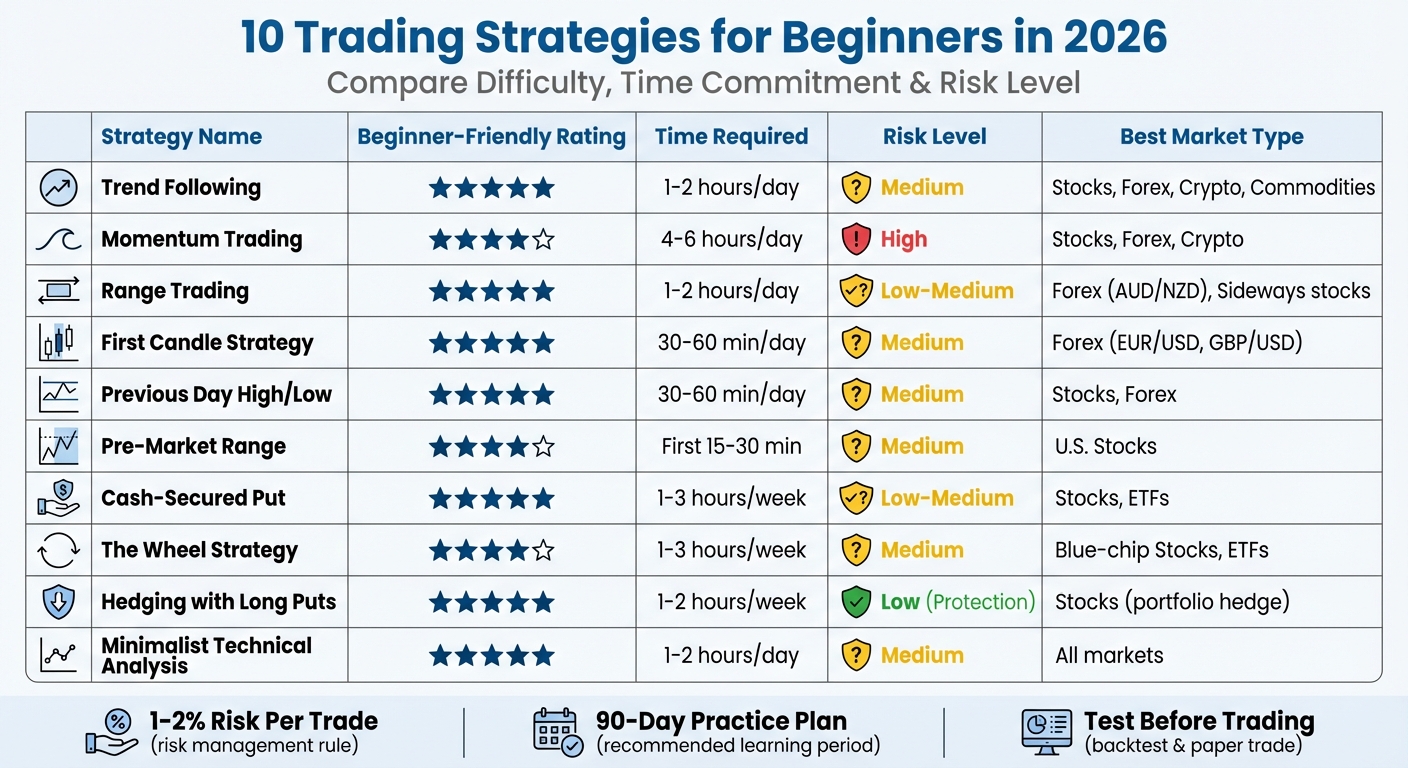
Trading in 2026 offers new opportunities with advanced tools like AI-driven analysis, tokenized assets, and automated systems. But success hinges on mastering strategies and risk management. Here’s a quick guide to the top beginner-friendly trading strategies:
- Trend Following: Ride market momentum using tools like moving averages. Focus on disciplined risk management with stop-loss orders.
- Momentum Trading: Jump into strong price movements and "buy high, sell higher." Use indicators like RSI and volume spikes for confirmation.
- Range Trading: Trade within predictable price channels by buying at support and selling at resistance.
- First Candle Strategy: Use the first trading session candle to set breakout trades.
- Previous Day High/Low Strategy: Trade around key levels from the prior day’s price action.
- Pre-Market Range Strategy: Identify high/low ranges during the market open for potential breakouts.
- Cash-Secured Put: Sell puts on stocks you’re willing to own, earning premiums while managing risk.
- The Wheel Strategy: Combine selling puts and covered calls for consistent income.
- Hedging with Long Puts: Protect your portfolio by limiting downside risk with put options.
- Minimalist Technical Analysis: Use a few key indicators like VWAP and RSI for clear, actionable insights.
Key Takeaways:
- Risk Management: Limit risk to 1-2% per trade. Use stop-loss orders and maintain a favorable risk-to-reward ratio.
- Adapt to Markets: Strategies vary across stocks, forex, and crypto. Choose based on time, risk tolerance, and market behavior.
- Test Before Trading: Backtest and paper trade strategies to refine them before using real money.
Focus on discipline, consistent execution, and learning from mistakes to build long-term trading success.
10 Best Trading Strategies for Beginners 2026 Comparison Guide
The Simplest Way To Start Day Trading In 2026 (Full Course)
sbb-itb-d544328
1. Trend Following
Trend following is a systematic trading approach that focuses on identifying the market’s current direction by observing patterns like higher highs and higher lows in an uptrend – or the opposite in a downtrend. The beauty of this strategy lies in its straightforwardness: instead of trying to predict when the market will turn, you simply follow the momentum that’s already underway.
Beginner-Friendliness
This strategy is especially appealing to beginners because it takes the guesswork out of trading. Rather than relying on perfect timing or trying to foresee the future, trend following waits for the market to confirm its direction before taking action. By sticking to clear, objective rules and using technical indicators like moving averages, traders can sidestep emotional decisions. As Forex Tester succinctly puts it:
Ride strong moves, exit weak ones.
How It Works in Practice
A typical approach involves analyzing different timeframes: daily charts to identify the trend, 4-hour charts for confirmation, and 15-minute charts for pinpointing entry points. Once a trend is spotted, wait for a pullback where the price retests the breakout level, now acting as support. Take Apple (AAPL) as an example from early 2024: the stock displayed a classic moving average crossover when the 20-period moving average moved above the 50-period moving average around $175. Traders who entered on the first pullback near $177 saw the stock climb to $195 over the following weeks – an $18 gain on a $4 risk, resulting in a reward-to-risk ratio of 4.5:1.
Risk Management
Trend following aligns perfectly with disciplined risk management, a cornerstone of any successful trading plan. Experts recommend risking no more than 1% to 2% of your total account balance on a single trade. To protect your position, place a stop-loss just below the most recent higher low, which ensures the trade remains within the trend. Using wider stops – about 2 to 4 times the Average True Range (ATR) – can help avoid being stopped out by regular market fluctuations. Once your trade is in profit, let it run by using trailing stops, such as those based on the Parabolic SAR or ATR. Even with a win rate as low as 30% to 45%, the larger profits from winning trades can keep your overall performance in the green.
Staying Relevant in 2026
As of 2026, trend following continues to be effective across a variety of liquid markets, including stocks, forex, commodities, and even cryptocurrencies. New tools, such as AI-powered charting and real-time sentiment analysis, make it easier than ever to distinguish genuine trends from market noise by combining news and social data. Automation has also taken this strategy to the next level, enabling trades to be executed automatically based on criteria like moving average crossovers or Donchian Channel breakouts. Additionally, the rise of tokenized assets and synthetic commodities opens up opportunities for around-the-clock trading, extending well beyond traditional market hours.
2. Momentum Trading
Momentum trading operates on a straightforward principle: buy high, sell higher. Instead of searching for undervalued assets, this approach focuses on stocks, forex pairs, or cryptocurrencies that are already showing strong upward movement. The goal is to ride the trend until the momentum slows down. As Richard Driehaus, a pioneer in momentum investing, famously said:
More money could be made by ‘buying high and selling higher’ than by buying underpriced stocks and waiting for the market to re-evaluate them.
Beginner-Friendliness
Momentum trading can be a great starting point for new traders because it eliminates some of the guesswork. You don’t have to predict when a trend will begin or end; instead, your task is to spot an ongoing trend and join it. This strategy works well in markets driven by "herding behavior", where traders, influenced by FOMO (fear of missing out), rush into the same assets. Your job? Identify when the momentum is building and hop on before it peaks.
Tools like the Relative Strength Index (RSI), Moving Averages, and the Stochastic Oscillator make it easier to gauge the speed and strength of price movements. These indicators provide clear signals, helping you to confidently apply momentum trading techniques.
Actionability
By 2026, spotting momentum has become quicker and more accurate thanks to algorithmic tools that can analyze thousands of assets in mere nanoseconds. To increase your chances of success, look for three key signals before entering a trade:
- Price reaching higher highs
- Volume surging 2–3× above its average
- RSI breaking above 60 or 70
For example, a backtested 20-day high breakout strategy on EUR/USD from 2010 to 2024 achieved a 17% compound annual growth rate, even with a win rate of just 38%. Timing is crucial – many traders find the first hour after the London and New York markets open to be the most effective, as liquidity peaks and breakouts tend to be cleaner.
Risk Management Suitability
Momentum trading comes with its challenges, particularly the risk of sudden reversals. That’s why strict stop-loss rules are essential. Place your stop-loss just below the most recent swing low for long positions, or use a trailing stop based on the Average True Range (ATR). This approach locks in profits while giving your trade some breathing room.
Never double down on a losing momentum trade. If the trend stalls, it’s better to exit immediately. Research shows that even with win rates as low as 38%, disciplined risk management can keep your overall returns positive. Focus on highly liquid assets, such as blue-chip stocks or major forex pairs, to ensure you can exit quickly if momentum fades. With proper risk controls, this strategy works well in fast-paced markets.
Adaptability to 2026 Market Conditions
The trading environment in 2026 is ideal for momentum strategies, thanks to high volatility in assets like silver and major forex pairs such as EUR/USD. Modern trading platforms now offer real-time alerts for volume spikes and breakouts, making it easier to seize short-term opportunities. For those who prefer a more passive approach, momentum-focused ETFs like MTUM provide exposure to this strategy without the need for manual chart analysis. Whether you’re trading stocks, forex, or crypto, momentum trading thrives in today’s fast-moving markets – just remember to stay disciplined and manage your risk carefully.
3. Range Trading
Range trading operates on a straightforward idea: buy when prices are near the lower boundary (support) and sell when they approach the upper boundary (resistance) of a defined price channel. Unlike trend-following strategies, this approach focuses on assets that move sideways within predictable ranges. Since financial markets only trend about 20% to 30% of the time and spend the rest – roughly 70% to 80% – in consolidation, range trading capitalizes on these frequent non-trending phases.
Beginner-Friendliness
This strategy is particularly approachable for beginners because it relies on well-defined price boundaries rather than intricate trend analysis. Recognizing when the market is trading sideways is a key skill, and range trading makes it easier to spot these conditions.
To establish a reliable range, look for price levels that have been tested multiple times – at least twice as support and twice as resistance. Tools like the Average Directional Index (ADX) can help confirm the absence of a strong trend; readings below 20 or 25 indicate a weak trend. A practical example is the AUD/NZD currency pair, which often trades within a 1,050-pip range, with support around 1.0250 and resistance near 1.1300. This reflects the economic ties between Australia and New Zealand.
Actionability
Once you’ve identified a range, you can streamline your trades with limit orders. Place a buy limit order just above the support level and a sell limit order just below resistance to lock in favorable price points. Oscillators like the RSI (oversold below 30; overbought above 70) and the Stochastic Oscillator (oversold below 20; overbought above 80) can confirm entry and exit points, helping you avoid emotional decision-making and reducing the need for constant monitoring.
One key tip: avoid trading in the middle of the range. Price movements here tend to lack a clear directional bias, making the risk-to-reward ratio less appealing.
Risk Management Suitability
Discipline is essential in range trading, especially when it comes to managing risk. Set strict stop-loss orders just outside the range boundaries – below support for long positions and above resistance for short positions. This protects your capital if the range breaks and a new trend begins. Remember, support and resistance levels are better understood as zones rather than exact price points, allowing for small fluctuations during volatile periods.
Volume analysis can also guide your decisions. A drop in volume near a boundary often signals a bounce, while a spike could indicate an imminent breakout. If you notice unusually high volume at a key level, it’s a good idea to exit the trade promptly. This structured approach pairs well with the risk management strategies covered in the next section.
Adaptability to 2026 Market Conditions
Looking ahead to 2026, range trading remains a practical strategy, especially as technology and market volatility evolve. For instance, commodities like silver have faced increasing volatility, and the EUR/USD has encountered strong resistance at 1.1900. Advances in trading platforms now make it easier than ever to automate this strategy, with tools that trigger orders as prices approach key levels. These developments provide traders with a reliable way to profit when markets lack clear trends.
4. The First Candle Strategy
The First Candle Strategy, also called the Opening Range strategy, is all about using the first completed candle of a trading session to guide your trades. Here’s how it works: once the first candle of a major session closes, you place a buy stop 2 pips above its high and a sell stop 2 pips below its low. When one of these orders is triggered, you cancel the other, allowing you to ride the initial breakout momentum without overthinking. This straightforward approach makes it a great choice for beginners.
Beginner-Friendly Approach
This strategy is perfect for those just starting out because it removes the need for complicated analysis. Instead of relying on intricate indicators or chart patterns, you simply focus on the high and low of the first candle. It’s simple: spot the first candle of a major session, set your pending orders, and you’re ready to go. Trading highly liquid pairs like EUR/USD or GBP/USD helps ensure tighter spreads and more reliable breakouts.
How to Put It Into Action
You can use 1-hour candlesticks for more stable signals or go with 15-minute candlesticks if you’re after quicker trades. Once your entry is triggered, set your stop-loss based on the range of the first candle, adding a small buffer of about 2 pips to guard against false breakouts. For profit targets, consider aiming for a fixed 20 pips if you’re scalping or use a reward-to-risk ratio of 1.5:1 to 2:1 for longer trades. By 2026, most trading platforms allow you to automate this process using bracket orders that handle your entry, stop-loss, and take-profit levels all at once. To make the most of this strategy, trade during high-volatility periods like the London and New York session overlaps.
Managing Risk Effectively
Good risk management is key to making this strategy work. Limit your risk per trade to 0.25%–0.5% of your total account equity. To calculate your position size, divide your maximum risk per trade by the product of your stop distance and the pip or tick value. It’s also smart to set a daily loss limit – such as stopping for the day after a 1.5%–2% drawdown or three consecutive losses – to protect your capital during unpredictable market swings. Place your stop-loss 5–10 pips beyond the entry candle to account for minor volatility. These safeguards will help you stay disciplined, even as market dynamics shift in 2026.
Staying Relevant in 2026
The First Candle Strategy continues to hold its ground in 2026, especially during high-liquidity times like the London Open (3:00–6:00 AM ET) and the New York Open (8:30–11:00 AM ET). However, steer clear of trading the first candle during major news events, such as CPI releases or Non-Farm Payroll reports. These events can cause wider spreads and slippage, which can derail your trades. Many traders are now incorporating AI-driven sentiment tools and adaptive stop-loss systems to fine-tune their entries and exits using real-time data. This blend of simplicity and modern tools keeps the strategy effective in evolving markets.
5. Previous Day High/Low Strategy
This strategy taps into one of the simplest yet effective trading techniques by using the previous day’s high and low as key levels. These price points often act as support and resistance, closely observed by institutional traders. Before the market opens, mark these levels on your chart to define your trading boundaries. The best part? It’s all about price action – no need for complicated indicators or formulas.
Beginner-Friendliness
This approach is ideal for beginners because it focuses on clear, objective price levels rather than relying on complex calculations. It provides straightforward entry and exit rules, which help reduce emotional decision-making. For range-bound markets, the idea is simple: buy near the previous day’s low and sell near the high. If you’re trading breakouts, consider going long when the price breaks above the previous high or short when it drops below the previous low. By 2026, AI tools even send alerts when these levels are reached, making it even easier to stay on top of the action.
Actionability
To make this strategy work, patience is key. Wait for confirmation before jumping into a trade. For example, only enter after a candle closes beyond the previous day’s high or low to avoid getting caught in a false breakout. A volume spike – at least 150% of the average – can signal institutional activity and validate the breakout. Profit targets can be set at the opposite end of the previous day’s range or at the next significant support or resistance level. This combination of clear levels and modern AI tools bridges traditional methods with today’s tech-driven trading.
Risk Management Suitability
One of the strengths of this strategy is its built-in risk management. With stop-losses placed just beyond the previous day’s range, your risk is well-defined. This makes it easier to calculate position sizes and aim for a favorable risk-to-reward ratio, such as 1:2, ensuring that winning trades cover the occasional losses from false breakouts. To manage risk effectively, combine volume confirmation with waiting for a candle to close beyond the key levels. Also, avoid trading just before major economic announcements, which can lead to unpredictable price swings.
Adaptability to 2026 Market Conditions
Even in 2026, this strategy holds up well, especially when trading liquid instruments like EUR/USD or large-cap stocks. Institutional traders still monitor these levels closely, maintaining their relevance. Modern platforms now integrate AI tools like pattern recognition and sentiment dashboards, helping traders distinguish genuine breakouts from short-term noise. With markets influenced by factors like interest-rate changes and rapid AI sector growth, these horizontal levels provide clarity amid uncertainty. Many traders now pair traditional price action with AI-driven sentiment analysis from news and social data, offering an added layer of validation for breakout strength. This blend of classic and modern techniques ensures the strategy remains effective in today’s fast-moving markets.
6. Pre-Market Range Strategy
The Pre-Market Range Strategy focuses on identifying the high and low price levels established during a specific period before or at the official market open. For U.S. stocks, this typically involves observing the first 15 to 30 minutes after the opening bell at 9:30 AM Eastern Time. The opening price often aligns with either the session’s high or low, providing a straightforward reference point. This approach, like other rules-based strategies, reduces emotional decision-making by relying on clear market signals.
Beginner-Friendliness
This strategy is particularly appealing to beginners because it offers simple, objective entry and exit points based on clearly defined price levels, rather than relying on complex chart patterns. All you need to do is define the early trading window, note the high and low prices, and watch for a confirmed breakout. This removes much of the uncertainty and emotional guessing that new traders often face. As Forex Training Group explains:
The opening price is the most important piece of data for short-term traders, particularly day traders seeking to extract a reliable edge from trading the intraday session.
Many trading platforms now provide free automated indicators that can map out these levels for you, eliminating the need for manual calculations.
Actionability
To put this strategy into practice, start by monitoring price movements during your chosen window – whether that’s the first 15 or 30 minutes after the market opens. Identify the high and low points during this time, then wait for a complete price candle to close beyond these levels, ideally accompanied by a volume spike. Place your stop-loss within the range and aim for a minimum 2:1 risk-reward ratio. If the price falls back into the range, exit the trade immediately.
Risk Management Suitability
One of the standout features of this strategy is its built-in risk boundaries, which make it easier to calculate position sizes and manage your capital responsibly. Limit your risk to no more than 0.25%–1% of your trading capital per trade. Historical data shows that Opening Range Breakout strategies have a win rate of 42% to 65%, making effective risk management critical to long-term success.
Adaptability to 2026 Market Conditions
With the advancements in technology, the Pre-Market Range Strategy has become even more effective in 2026. The availability of affordable, real-time data and automation tools allows for a more structured, rules-based approach. Modern trading platforms now incorporate AI-driven analyses and machine learning-calibrated volatility bands to help pinpoint support and resistance levels with greater accuracy. AI sentiment indicators are also being used to confirm the strength of breakouts. Additionally, there’s a growing trend of leveraging pre-market and opening range signals to trade zero-day-to-expiration options. As Quadcode notes:
In 2026, technology will be the main difference. Even retail traders now have widespread access to real-time data feeds, AI-assisted analysis, and automated trade execution systems.
7. Cash-Secured Put Strategy
Building on our lineup of beginner-friendly trading strategies, the cash-secured put strategy stands out as a cautious yet effective approach in today’s ever-changing market landscape.
This strategy involves selling a put option on a stock while holding enough cash to buy 100 shares at the strike price if you’re assigned. It’s ideal for traders with a neutral-to-bullish outlook who want to generate income or acquire stocks at a discount. The upfront premium you receive is yours to keep, regardless of whether the option gets exercised. If the stock stays above the strike price, the option expires worthless, and you pocket the premium. If it falls below, you’ll buy the stock at the agreed price, with the premium reducing your overall cost basis.
Beginner-Friendliness
This strategy is straightforward and avoids the complexities of margin trading, making it a great starting point for newcomers. As Schaeffer’s Investment Research explains:
Writing cash-secured puts is one of the best ways to learn how options work without the risk of a margin call.
Think of it like getting paid to place a limit order. Unlike a traditional limit order, where you simply wait, a cash-secured put pays you a premium for agreeing to purchase the stock at your target price. Conservative traders often aim for a delta between -0.20 and -0.30, which reflects a 20% to 30% chance of being assigned the stock.
How to Get Started
To implement this strategy, choose high-quality stocks or ETFs you’d be comfortable owning. Make sure you have enough cash to cover the strike price multiplied by 100 shares. Then, sell an out-of-the-money put contract on a liquid asset – this ensures tighter bid-ask spreads, typically around 10 to 20 cents. Aiming for strike prices 5% to 10% below the current stock price often generates monthly returns of 1% to 2%, with a 20% to 35% chance of assignment. To manage risk, avoid allocating more than 10% of your portfolio to a single stock and maintain 20% to 30% of your account in cash reserves for added flexibility.
Managing Risk
Your maximum potential loss is the strike price minus the premium you received, which also defines your breakeven point. On average, cash-secured puts can yield 1%–3% monthly or 12%–36% annually. If the option loses most of its value, consider closing the position early to lock in profits. As with any strategy, disciplined risk management is key to making cash-secured puts a reliable part of a beginner’s trading toolkit.
Relevance in 2026 Markets
In the volatile conditions of 2026, heightened market swings have led to higher option premiums. Advanced tools like AI-driven sentiment analysis and satellite data now help traders identify ideal entry points, making cash-secured puts an appealing alternative to low-interest savings accounts. With defined risks and accessible technology, this strategy remains a practical choice for those new to trading.
8. The Wheel Strategy
The Wheel Strategy takes the cash-secured put method a step further, creating a structured cycle for generating consistent income. This approach combines earnings from put premiums, call premiums, and potential stock appreciation into a repeatable system. If the stock price drops enough for assignment, you purchase 100 shares at the strike price and then sell covered calls on those shares. By transitioning seamlessly from selling puts to selling calls, the strategy ensures a steady flow of income.
Beginner-Friendliness
This three-step system simplifies decision-making by relying on clear, repeatable rules. Traders typically aim for strike prices with a delta between 0.20 and 0.35 and choose expiration dates within 20 to 45 days to take advantage of time decay.
How to Get Started
To use the Wheel Strategy, start by creating a watchlist of highly liquid blue-chip stocks or ETFs, such as those tracking the S&P 500, that you’re comfortable holding for the long term. Make sure you have enough cash set aside to cover each contract – for instance, a $45 strike price means you’ll need $4,500 in reserve. Avoid selling puts right before major events like earnings announcements. It’s also smart to set profit-taking rules, such as closing positions once you’ve captured 50% of the maximum profit, to help manage risks effectively.
Managing Risks
One potential downside of the Wheel Strategy is ending up with shares that lose significant value beyond the premiums collected. To mitigate this, limit each put sale to only 1%–2% of your total capital. If the stock price drops sharply, you can "roll" the put by closing the current position and opening a new one at a lower strike price, which allows you to collect additional premiums while adjusting your position.
Staying Relevant in 2026
By 2026, advances like AI-driven volatility forecasting and real-time Greeks optimization have made it easier to fine-tune this strategy. Retail investors now have access to institutional-grade data and automated alerts, which can help pinpoint oversold conditions – ideal moments to sell puts. With interest rates stabilizing and volatility steady in sectors like semiconductors and green technology, the Wheel Strategy continues to be a reliable way to generate income in sideways or modestly bullish markets. Its disciplined, cyclical nature makes it a valuable tool for traders navigating today’s market conditions.
9. Hedging with Long Puts
Using long puts as a hedge is like buying insurance for your stock portfolio. By purchasing a put option on shares you already own – commonly referred to as a "protective put" – you lock in a minimum selling price, regardless of how much the stock drops. Of course, this comes at the cost of a premium. Since one standard options contract covers 100 shares, you’ll need two contracts to fully protect 200 shares[67,69,72].
What makes this strategy appealing is that it limits your downside while leaving your upside open. If the stock rises, the put expires worthless, and you still benefit from the gains (minus the cost of the premium). If the stock takes a nosedive, the put allows you to sell at the strike price, capping your losses. For instance, if you buy 100 shares at $290.75 and a put for $2.70, your cost basis becomes $293.45 per share. This provides a safety net against sharp declines while keeping your potential gains intact[67,72].
This method works well alongside other risk management strategies, offering a straightforward way to protect your investments.
Beginner-Friendliness
Hedging with long puts is relatively easy to grasp. It boils down to two key decisions: selecting a strike price and choosing an expiration date. Michael Martin, VP of Market Strategy at TradingBlock, explains:
The protective put strategy is a bullish options trade that pairs long stock with a put option to hedge against potential losses.
Unlike stop-loss orders, which can be triggered by temporary price swings, a long put provides consistent protection throughout the life of the option[68,74].
Actionability
To put this strategy into practice, start by selecting a strike price about 3% to 5% below the current stock price. This strikes a balance between affordability and effective protection. Look for a delta of around -0.30, which ensures the option is sensitive to price drops while keeping costs manageable. Choose puts with 30 to 90 days until expiration, and as the expiration date approaches (around 30 days left), consider rolling the position to reduce time decay. Additionally, keep an eye on implied volatility – hedging is generally cheaper when volatility is low.
Risk Management Suitability
This strategy is designed to cap your losses at the cost of the premium plus the difference between your purchase price and the strike price of the put. It’s a safer alternative to shorting stock. However, it’s important to note that time decay accelerates as the option approaches expiration, especially in the last 45 days[67,69,72]. As Michael Martin highlights:
Buying protection in a high IV environment means you’re likely paying up. Sometimes it’s worth it, but if volatility drops after you enter the trade, your put can lose value even if the stock moves lower.
Adaptability to 2026 Market Conditions
Protective puts are particularly useful in uncertain times, and 2026 is shaping up to be one of those periods. With markets experiencing heightened volatility and major currency pairs hitting resistance levels, this strategy offers a reliable way to manage risk. Advances in AI-driven volatility forecasting now help traders identify the best times to enter these hedges. Plus, many automated trading platforms make it easy to execute these trades with the proper ratio of 100 shares per put contract. Protective puts are especially effective during events like Federal Reserve meetings or earnings announcements, where the direction of the market may be unclear, but significant price swings are expected[67,68,69].
10. Minimalist Technical Analysis Approach
For those diving into beginner-friendly trading strategies in 2026, this approach keeps things simple. The minimalist technical analysis method emphasizes using just a handful of essential indicators to avoid overcomplicating your charts and decision-making process. Instead of cluttering your screen with endless tools, you focus on a few key indicators – like Moving Averages (EMAs), Volume Weighted Average Price (VWAP), and the Relative Strength Index (RSI) – to track clear price movements and trends effectively. As Forex Tester puts it:
Keep the stack lean so signals don’t conflict.
This strategy also promotes discipline with well-defined rules. Many traders stick to risking only 1% per trade and use the Average True Range (ATR) indicator to set stop-loss levels based on market volatility.
Beginner-Friendliness
This method is particularly beginner-friendly because it relies on straightforward indicators, making it easier to navigate unpredictable markets. As Investopedia explains:
While it may be tempting to employ as many indicators as possible, selecting the ones that are most relevant to you… can make a significant difference without the need to overhaul your entire strategy.
By focusing on just a few indicators, traders can hone in on decisive signals rather than getting overwhelmed by conflicting data.
Actionability
To apply this strategy, limit your chart to one to three indicators – such as VWAP, a 20-period EMA, and ATR. Keeping your setup clean ensures that signals are easy to interpret. Pre-defined stop-losses, combined with backtesting tools, allow you to refine your entry and exit strategies before risking real money. This approach emphasizes rule-based trading, which is crucial in the fast-moving markets of today.
Risk Management Suitability
Simple, rule-based trading makes it easier to identify when a trade setup no longer holds up, which is vital for managing risk. For instance, many traders follow a rule of halting trading after three consecutive losses or when daily losses hit 1.5% to 2% of their account. These disciplined guidelines help avoid emotional decisions that could lead to bigger losses.
Adaptability to 2026 Market Conditions
With 2026 markets dominated by AI-driven volatility and rapid news cycles, this minimalist approach helps cut through the noise. By focusing on core price action and avoiding a cluttered screen of lagging indicators, traders can make clearer decisions. While modern platforms provide advanced tools like sentiment analysis and pattern recognition, the essence of trading remains the same: discipline and simplicity win the day.
Risk Management Basics Every Beginner Needs
Building on the strategies mentioned earlier, solid risk management is the cornerstone of long-term trading success. Here’s a sobering fact: if you lose 50% of your trading account, you’ll need a 100% gain just to recover.
Ed Seykota, a legendary trader, once summed it up perfectly:
There are three rules to successful trading, and each one is to "cut your losses."
A good starting point is sticking to the 1% to 2% risk rule. Let’s break it down: if your account is $10,000 and you risk 1% per trade, you’re putting $100 on the line. This strategy gives you the ability to withstand 100 consecutive losses without wiping out your account. On the other hand, risking 10% per trade means just 10 losses could drain your entire balance. To manage this effectively, use the formula:
Position Size = (Account Balance × Risk %) / Stop-Loss Distance.
This calculation ensures that every trade aligns with your risk tolerance and helps you balance potential gains against possible losses.
Stop-loss orders are your safety net. Place them 5 to 10 pips beyond recent highs or lows to protect yourself from sudden market gaps, especially during major events.
Another key to success is maintaining a strong risk-reward ratio. Aim for at least 1:1.5 or 1:2, meaning your potential profit should be 1.5 to 2 times greater than your potential loss. This approach allows you to remain profitable even if you win less than half your trades. Tools like bracket orders can help by automating your entry, stop-loss, and take-profit levels.
Emotional discipline is just as important as technical strategy. As Investopedia wisely points out:
A successful trader can give their system to a rookie, and the rookie will end up losing all of their money because they can’t keep emotion out of the trades.
To keep emotions in check, set a daily loss limit – say, 1.5% of your account. If you hit that limit, stop trading for the day. This prevents impulsive "revenge trading" and keeps your decision-making rational.
How to Backtest and Paper Trade Your Strategy
Before putting your hard-earned money on the line, it’s essential to test your trading strategy. Backtesting lets you see how your trading rules would have performed using historical data, while paper trading applies those same rules in live markets but with virtual funds instead. Think of backtesting as a historical simulation and paper trading as a live practice run – both are designed to help you refine your approach without financial risk.
Start by defining clear rules for your trades: when to enter, where to place stop-losses, and how to set profit targets. Use high-quality historical data that spans different market conditions – bull, bear, and sideways trends – to get a comprehensive view of how your strategy holds up. For instance, Binance Academy backtested a "Golden Cross" strategy on Bitcoin (where the 50-day moving average crosses above the 200-day moving average) from January 2019 to December 2020. The results? Two completed trades: one with a profit of about $3,800 and another with a loss of around $2,900, resulting in a net gain of $900. Additionally, there was an open trade showing $9,000 in unrealized gains at the time of the test.
To get reliable results, aim to backtest with at least 50 to 100 trades. A smaller sample size can lead to skewed outcomes due to luck. Don’t forget to account for real-world costs like commissions, spreads, and slippage – ignoring these could turn what looks like a winning strategy into a losing one. For example, investment strategist Cedric Thompson backtested a 4-hour EMA trend-following strategy on the SPY (S&P 500 ETF) in February 2025. His system generated a net profit of $1,737 over 15 trades, with a win rate of 53.33% and an average profit of $115.80 per trade. However, the test also revealed a maximum drawdown of $945, emphasizing the importance of refining stop-loss placements.
Once your backtesting results are promising, transition to paper trading using a demo account. This step is critical because backtesting doesn’t capture the emotional challenges of watching live markets move against your position. Paper trading also uncovers practical issues like execution delays and real-time market spreads that historical data can’t simulate. According to TradingView, thorough validation through backtesting and paper trading can cut potential trading losses by up to 50%. During this phase, keep a detailed trade journal. Record every entry, exit, and even your emotional responses to market fluctuations – this insight can be invaluable for improving your strategy.
Be cautious of overfitting, where your strategy becomes too tailored to past data and fails in live conditions. Also, avoid biases like survivorship bias (testing only stocks that still exist) and look-ahead bias (using future information for past trades). If your strategy performs consistently in both backtesting and paper trading, you’ll be in a stronger position to trade with real capital. This step-by-step process not only reinforces sound risk management but also prepares you for the challenges of live trading and ongoing strategy adjustments.
Choosing Your First Trading Strategy
In the fast-paced markets of 2026, picking the right trading strategy can make all the difference. Instead of trying to juggle multiple approaches, focus on mastering one. This not only builds discipline but also increases your chances of long-term success. As DayTradingToolkit.com wisely states:
The market rewards specialists, not generalists who know a little about everything. Become the expert in YOUR strategy, and the profits will follow.
This level of focus helps align your strategy with both your lifestyle and your tolerance for risk.
Match Strategy to Your Schedule
Your available time is a major factor when choosing a strategy. For example:
- Day trading demands 4–8 hours of screen time daily.
- Swing trading requires about an hour each day.
- Position trading needs as little as 1–3 hours per week.
If you’re working full time, strategies like Trend Following or Range Trading might fit better than approaches like Momentum Trading or the Pre-Market Range Strategy, which need constant attention during market hours.
Consider Your Risk Tolerance
Your comfort with risk is another critical element. If you find large account swings stressful, steer clear of high-volatility strategies like day trading or scalping. Instead, explore steadier options such as position trading or Cash-Secured Puts. Similarly, risk-averse traders might prefer major currency pairs or large-cap stocks over more volatile instruments like exotic currencies or small-cap stocks.
Align With Your Style and Goals
Think about what excites you most about trading. If you enjoy staying updated on current events, a news-driven strategy might suit you. If you’re more drawn to charts and patterns, technical strategies could be a better fit. Also, decide whether trading will be your primary income source or just a way to supplement your earnings.
Stick to a 90-Day Plan
To build expertise, commit to a structured 90-day plan:
- Spend the first 30 days paper trading several strategies.
- Dedicate the next 30 days to refining and narrowing down your choice.
- Use the final 30 days to practice your chosen strategy before trading with real money.
Applying Strategies Across Different Markets
You can apply trading strategies across stocks, forex, and crypto, but each market operates with unique characteristics. Stocks tend to favor longer-term trends because institutions often hold positions for value appreciation. Forex, with its massive liquidity – averaging a daily turnover of $7.5 trillion in 2022 – is well-suited for range trading, as currency pairs frequently move within predictable channels. On the other hand, crypto runs 24/7 and is heavily influenced by momentum bursts triggered by major news or regulatory changes.
The financial mechanics of these markets also vary widely. Leverage is a prime example: stock traders generally use 2:1 leverage, forex traders can access up to 100:1, and crypto traders often encounter even higher leverage levels. For instance, with high leverage, a $1,000 forex account can control up to $100,000, significantly amplifying both potential gains and risks. To manage this, using mini or micro lots (1,000 or 100 units) can help absorb larger drawdowns – sometimes up to 2,000 pips – without triggering a margin call.
Fundamental analysis also varies across these markets. Stock traders focus on metrics like earnings reports and revenue growth. Forex traders, however, monitor economic events such as CPI data, Federal Open Market Committee (FOMC) decisions, and interest rate differentials that influence carry trades. By 2026, crypto markets are increasingly shaped by regulatory frameworks like the OECD’s Crypto-Asset Reporting Framework (CARF), which mandates detailed user data reporting by exchanges starting January 1, 2026. Adrian Ashley, a seasoned trader, emphasizes:
A trading strategy is more than just an entry signal, but it’s a complete set of rules covering market conditions, risk management, and execution steps.
These differences also dictate the timeframes and chart analyses you should use. For stocks, daily or weekly charts help filter out short-term noise. In forex, 1-hour or 15-minute charts are better suited for capturing intraday volatility. By 2026, advanced volatility filters make it easier to distinguish structural market moves from temporary price spikes. For swing trades, align technical analysis with fundamentals – for example, short EUR/USD when the Federal Reserve is tightening monetary policy, while the European Central Bank maintains a steady course.
Gap risk is another factor to consider. Stocks can experience significant price jumps between the previous day’s close and the next day’s open. In contrast, forex’s 24/5 trading and crypto’s 24/7 trading schedules reduce this risk. However, crypto comes with its own challenges, like liquidation risks and vulnerabilities in certain protocols that are absent in regulated stock exchanges. To navigate volatile crypto markets, confirm breakouts with volume spikes to avoid falling for fakeouts.
Mistakes New Traders Make and How to Avoid Them
To build a strong trading foundation, it’s crucial to avoid common pitfalls. Let’s break down some frequent mistakes and how to steer clear of them.
Overleveraging is a quick way to wipe out your account. For instance, using 50:1 leverage means that just a 2% unfavorable move can completely deplete your capital. A safer approach? Stick to the 1% Rule – risk no more than 1% (or even 0.5%) of your total account equity on a single trade. If you’re just starting out, micro contracts are a cost-effective way to gain experience without putting too much on the line.
Emotional decision-making often leads to revenge trading – where you increase your position size to recover losses. This is a slippery slope that can undo months of hard work. To keep emotions in check, set a maximum daily loss limit of 1%–2% and take a break after three consecutive losses. A trade journal can also help; include an "emotion rating" to spot patterns in your decision-making.
Neglecting stop-loss orders can turn small setbacks into massive losses. As discussed in risk management basics, sticking to predefined stop-loss levels is non-negotiable. Place your stop-loss just below a recent swing low, adding a 1–2 tick buffer. Bracket orders are a great tool to automate both stop-loss and take-profit levels. For perspective, during the quarter ending June 30, 2024, 35.3% of IG Group’s active non-discretionary trading accounts reported losses – often due to poor capital protection.
Skipping strategy testing is like flying blind. Before putting real money on the line, paper trade your strategy for 3 to 6 months. When you’re ready to go live, start small – use just 1% to 5% of your available capital to ease into the transition. Demo accounts with real-time data are excellent for practicing without financial risk.
Over-trading and lack of focus can spread you too thin, making it harder to master any single market or strategy. Instead, zero in on one market, one timeframe, and one strategy until you’ve built a solid skillset. As Joshua Soriano wisely says:
The goal is not to trade more. The goal is to trade better.
Conclusion
Achieving success in trading isn’t about discovering a flawless strategy – it’s about protecting your capital and maintaining consistent execution. Even the most profitable strategy can fail without disciplined stop-losses and proper position sizing. As Adrian Ashley wisely states:
A strategy is only as good as your ability to execute it consistently.
Risk management plays a critical role in trading. Just one careless trade can wipe out weeks of progress. Professional traders often limit their risk to just 0.25% to 0.5% of their account per trade, ensuring they can stay in the game for the long haul. This level of discipline is the foundation for managing the emotional hurdles that inevitably arise.
Emotional control is another key factor in trading success. Automating orders can help minimize impulsive decisions. Developing a consistent daily routine – complete with pre-market preparation, focused trading sessions, and post-trade reviews – can further enhance discipline. Setting a firm daily loss limit, such as 1.5% of your account, is also essential to avoid the pitfalls of revenge trading.
Practical routines, like the "5-3-1" rule, can help traders maintain focus and discipline. This approach involves tracking five currency pairs, applying three specific strategies, and dedicating one set time to trade each day. It’s designed to prevent overextending and to keep trading efforts manageable. Even small, rule-based losses should be reframed as wins in discipline, reinforcing the importance of sticking to a plan.
The path to sustainable trading success lies in building a reliable edge through disciplined execution and setting realistic goals. Starting with micro contracts and maintaining a concise trade journal can provide a solid foundation. As Joshua Soriano from Quant Matter puts it:
The goal is not to trade more. The goal is to trade better.
Consistent execution, disciplined risk management, and a commitment to continuous improvement are the cornerstones of lasting success in trading – principles that unify the strategies explored throughout this guide.
FAQs
What is the easiest trading strategy for beginners in 2026?
The simplest trading strategy for beginners in 2026 is trend following. This approach involves spotting a market trend and trading in the same direction, making it straightforward and easy to apply. It’s a great starting point for new traders since it reduces uncertainty and encourages a more careful approach to risk.
By concentrating on clear trends and using tools like moving averages or trendlines, beginners can gain confidence while getting familiar with how markets move. Plus, with the help of modern tools and AI advancements, this strategy becomes even more accessible, allowing traders to make informed decisions without overcomplicating the process.
How can beginners use AI tools to improve their trading strategies?
AI tools are transforming the way beginners approach trading by breaking down complex analyses and automating essential tasks. These tools can sift through massive datasets to spot trends, patterns, and signals, helping traders make smarter decisions without needing deep technical know-how.
On top of that, AI-powered platforms can handle backtesting strategies, manage risks, and even automate trade executions. This not only cuts down on emotional decision-making but also boosts efficiency, making it easier for newcomers to stick to disciplined trading methods. With AI, beginners gain access to advanced insights and tools that were once exclusive to seasoned professionals.
What are the best risk management tips for beginner traders?
Effective risk management is a must for new traders aiming to safeguard their capital and grow their confidence. A good starting point is to set stop-loss and take-profit levels for every trade. This approach helps limit potential losses while securing gains. Another key principle is the 1% rule – risking no more than 1% of your total trading capital on a single trade. This keeps setbacks manageable and protects your overall portfolio.
To further reduce risk, consider diversifying your portfolio across different assets. Spreading your investments can cushion the impact of a poor-performing trade. Additionally, hedging strategies, like using options, can offer protection against sudden market swings. Staying disciplined is equally important: follow a well-structured trading plan, avoid making decisions based on emotions, and regularly review your trades to identify and learn from mistakes.
Lastly, take the time to understand the specific risks tied to your chosen market. Factors like volatility or leverage can significantly influence your trading outcomes. By incorporating these practices, you’ll be better equipped to trade with confidence while keeping potential losses in check.