


AI Email Campaign Writing: Ultimate Guide
AI is transforming email marketing by making campaigns faster, smarter, and more effective.
Here’s why it matters:
- Efficiency boost: AI can draft emails, personalize messages, and optimize send times in seconds, saving marketers hours of work.
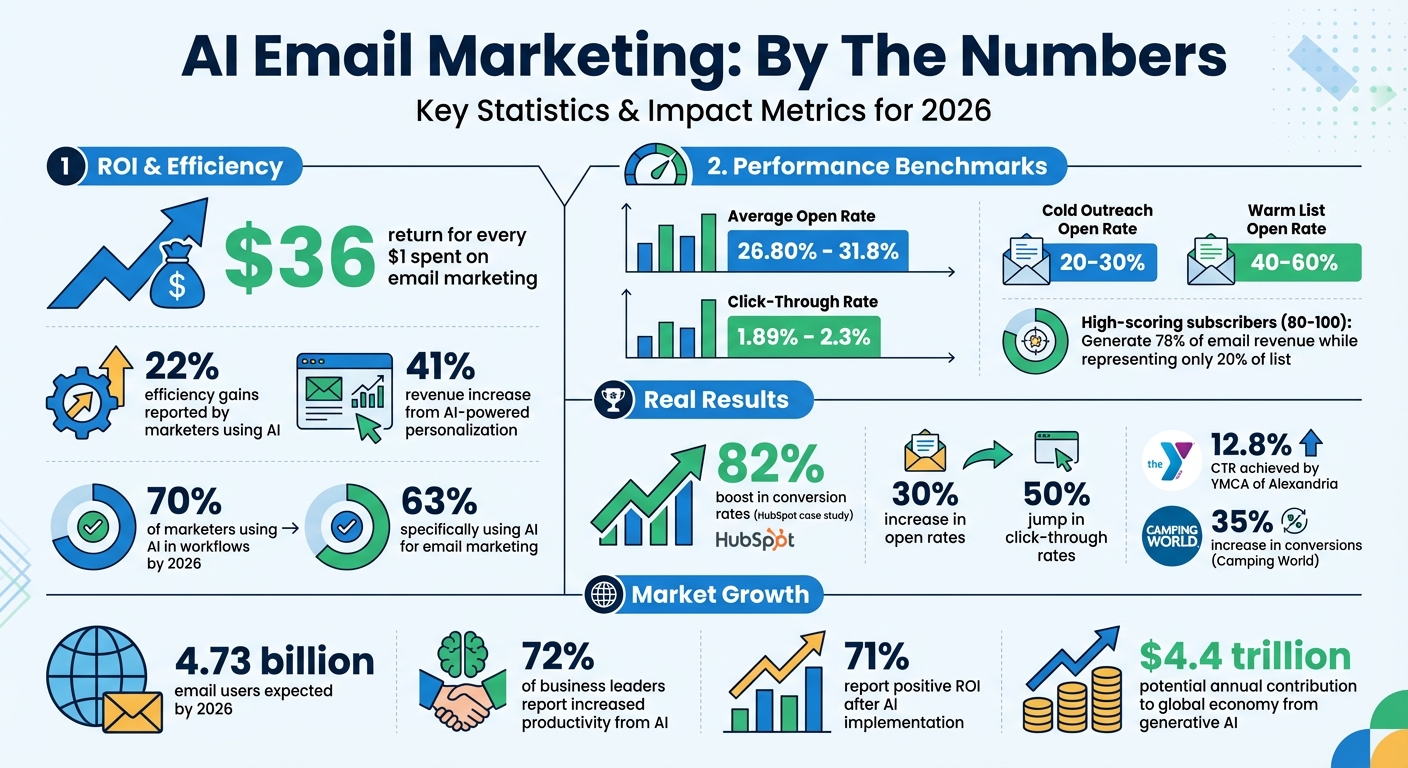
- Higher ROI: Email marketing generates $36 for every $1 spent, and AI-driven campaigns improve open rates, click-throughs, and conversions.
- Personalization at scale: AI tailors content based on real-time data, like user behavior and CRM insights, ensuring relevance without manual effort.
Marketers using AI report 22% efficiency gains, and tools like Salesforce Einstein and Instantly are driving better results with features like adaptive segmentation and automated follow-ups. Whether you’re a small business owner or part of a large team, AI can help you focus on strategy while handling repetitive tasks.
This guide covers tools, strategies, and metrics to help you create impactful email campaigns. Let’s dive in and explore how you can get started with AI-powered email marketing today.
AI Email Marketing Statistics and ROI Impact 2026
How to Use AI in Email Marketing | Best Proven Strategies
Top AI Tools for Email Campaigns
Choosing the right AI tool depends on what you’re aiming to achieve. Some tools are perfect for keeping your brand’s tone consistent, others help you scale personalization, and a few can even automate entire email sequences. Below are standout tools for brand voice training, personalization, and sequence automation.
Creaitor for Brand Voice Training
Creaitor shines when it comes to replicating your brand’s unique tone. You can train it using your most effective emails and brand guidelines, ensuring it produces content that feels authentic. It even taps into Semrush data to craft SEO-friendly email content while staying true to your voice. By analyzing uploaded writing samples, Creaitor identifies your language patterns, sentence structures, and word choices, making every email feel like it was written by your team.
For small businesses, this means shifting from lengthy drafting processes to quickly refining professional, on-brand content.
Salesforce Einstein for Personalization and Optimization
Salesforce Einstein blends predictive and generative AI to fine-tune both the timing and content of your email campaigns. It studies past engagement metrics – like open rates, click-through rates, and purchase history – to predict the best times to send emails and automatically segment your audience. On top of that, Einstein customizes content elements such as case studies, product recommendations, and pricing based on user data.
In 2025, HubSpot‘s demand generation team used GPT-4 technology to analyze user behavior, matching recipients with relevant content. This resulted in an impressive 82% boost in conversion rates, a 30% increase in open rates, and a 50% jump in click-through rates. For larger organizations, Einstein integrates seamlessly with your CRM, leveraging real buyer behavior for personalization. Pricing starts at $890 per month (billed annually), making it a strong option for enterprise-level campaigns.
Instantly for AI Sequence Automation
Instantly is tailored for sales teams and SDRs who need to scale cold outreach while maintaining personalization. Using AI, it creates customized icebreakers by pulling data from LinkedIn profiles, company websites, and even recent news. It also tweaks follow-up timing based on how prospects engage – triggering different sequences depending on whether the recipient opens the email, clicks, or ignores it entirely.
The platform streamlines the entire sales development process, from prioritizing leads to categorizing replies automatically. This eliminates the need for manual tracking and adjusts in real-time based on engagement signals. Instantly also offers email warm-up services to safeguard sender reputation and improve deliverability. Plans start at $39 per month for basic features, with enterprise-level options reaching $174 per month.
What sets Instantly apart is its ability to combine high-volume automation with smart sequencing that adapts to recipient behavior.
Proven Strategies for AI Email Campaigns
Creating successful AI-driven email campaigns requires clear instructions and precise data inputs. These strategies will help you craft emails that feel personal, perform better, and continuously improve.
How to Write Effective Prompts with Persona-Task-Context Formula
The effectiveness of AI-generated emails depends on how specific your prompts are. Vague instructions lead to generic results, while detailed prompts ensure the AI understands your needs. The Persona-Task-Context formula is a simple yet powerful way to structure these prompts, giving the AI three key pieces of information: the tone it should adopt, the task it needs to complete, and the purpose behind it.
- Persona defines the voice and authority. For instance, instead of saying, "Write an email", try something like, "Act as a marketing expert for an outdoor gear brand" or "Write in a fun, friendly tone".
- Task specifies the exact output you need. Examples include "Suggest three catchy subject lines" or "Draft body content highlighting eco-friendly benefits".
- Context provides the details – who the audience is (e.g., loyal customers or inactive subscribers), their challenge (e.g., finding sustainable gear), and the action you want them to take (e.g., shop a flash sale within 24 hours).
"Identify the audience, their pain point, and the action you want them to take to generate the best responses." – Column Five Media
A practical example comes from ActiveCampaign in June 2025. A mid-sized outdoor gear brand used the prompt: "Write an email announcing our new eco-friendly tent. Fun, friendly tone." The AI produced multiple drafts, including one that began with, "Hey Adventurers! 🏕️ Get ready to revolutionize your outdoor experience with our brand-new EcoNest Tent." This approach reduced campaign creation time from 120 minutes to just 20 minutes and boosted performance by 22% compared to previous manual efforts.
If the AI’s first draft isn’t perfect, provide specific feedback like "make it shorter" or "adjust the tone to be more helpful, less salesy". Think of AI as your co-pilot – it handles the structure while you add the emotional and strategic layers.
| Prompt Component | Purpose | Examples |
|---|---|---|
| Persona | Defines the tone and authority | "Friendly brand assistant", "Expert strategist" |
| Task | Sets the specific output | "Write a subject line", "Draft a 3-email sequence" |
| Context | Adds constraints and details | "Targeting frequent buyers", "Focus on eco-friendly benefits" |
Once you’ve mastered prompt writing, the next step is tailoring content using recipient data.
Personalizing Content Using Recipient Data and Behavior
AI makes it possible to personalize emails at scale, eliminating the need to choose between generic mass emails and time-consuming manual customization. The secret lies in leveraging data like job titles, company size, deal stages, website activity, and engagement history.
To maintain clarity and coherence, limit personalized fields to three per email block. For example, you might reference the recipient’s industry, a recent action they took (e.g., downloading a whitepaper), and their stage in the buyer journey. AI can even select the most relevant case study from your library based on the recipient’s industry, saving you the hassle of manual matching.
"Claude can reference live CRM data like job titles, deal stages, and tags to write emails that actually feel personalized." – HubSpot
Behavioral triggers take personalization further by aligning email content with real-time actions. For instance, if someone visits your pricing page but doesn’t convert, AI can adjust the next email to address common objections or offer a limited-time discount. This dynamic approach makes even cold outreach feel tailored and valuable.
The benefits are clear: 67% of marketers say AI saves them time by speeding up asset creation, and 50% report improved content quality.
With personalized content in place, continuous testing ensures your emails keep getting better.
A/B Testing Subject Lines, CTAs, and Full Variants
AI simplifies A/B testing, turning it into an ongoing process that evolves with each campaign. From a single brief, AI can generate multiple subject lines, body texts, and CTAs. Beyond generating options, predictive AI reviews your historical engagement data to recommend the most effective language, tone, or offer – before you even hit send.
Since 47% of email recipients decide to open an email based on its subject line alone, this is a critical area to test. Tools like Phrasee have helped marketers improve open rates by 20-30% through optimized subject lines. Tailor your tests to different stages of the customer lifecycle: focus on subject lines and preview text for awareness, value framing for consideration, and CTA placement for decision-making.
| Lifecycle Stage | Element to Test | Primary Metric |
|---|---|---|
| Awareness | Subject lines, preview text | Open Rate |
| Consideration | Value framing, content length | Click-Through Rate (CTR) |
| Decision | CTA placement, offer clarity | Conversion Rate |
| Retention | Dynamic content, send timing | Reply/Renewal Rate |
To get actionable insights, test one variable at a time. For example, don’t test subject line length and CTA wording simultaneously – it’ll be unclear which change made the difference. Set clear guidelines, like stopping after 1,000 sends or when you reach a 95% confidence level.
Always review AI-generated content to ensure it aligns with your brand and avoids clickbait, which can hurt trust and deliverability. The ultimate goal isn’t just higher open rates – it’s building trust and driving revenue. Segmented campaigns, powered by AI, can increase revenue by up to 760% compared to non-segmented ones.
"The winners will be marketers who can use AI to enhance human creativity, not replace it entirely." – Gordon Donnelly, Founder of Powerplay
sbb-itb-d544328
Implementation Best Practices
Refining your AI email campaigns requires a mix of precise training, real-time tracking, and seamless integration. These best practices will help you maximize their effectiveness.
Training AI on Brand Voice and Compliance
To make AI sound like your brand, you need to teach it. Start by feeding your AI tool detailed brand guidelines, clear objectives, and examples of successful past emails. Incorporating customer interviews, support tickets, and user behavior ensures the AI reflects what your audience truly needs.
AI is a powerful assistant, but human editors should always oversee its work to maintain authenticity. In 2025, AI-driven personalization helped boost the average email open rate across industries to 42.35%. However, trust is essential – ensure your campaigns follow GDPR and CAN-SPAM regulations and embrace transparent data practices.
When crafting prompts, be specific. For instance, instead of saying, "Write a promotional email", try: "Write a 150-word email in a friendly, conversational tone announcing our spring sale to customers who haven’t purchased in 60 days." This reduces the need for manual edits. Also, implement safeguards like AI-driven monitoring to track sending patterns and maintain a good sender reputation with ISPs, avoiding spam flags.
"AI should be the co-pilot, not the pilot. The most effective campaigns combine AI’s analytical power with authentic human touches." – Entrepreneur
Regularly auditing campaigns is another essential step. Check if the AI is leveraging deep behavioral data rather than just surface-level demographics like location. To connect on a personal level, add human elements that AI can’t replicate – such as handwritten PS notes or behind-the-scenes product stories.
Using Analytics for Performance Tracking and Iteration
AI analytics can transform your campaigns by adapting to real-time engagement. Move away from static lists and embrace dynamic segmentation that adjusts based on live customer signals. For example, predictive engagement scoring assigns a value (0–100) to subscribers, estimating their likelihood to open or click based on past behavior.
High-scoring subscribers (80–100) often drive 78% of email revenue, even though they may only make up about 20% of your list. These subscribers should get premium content, early access offers, or more frequent emails (3–5 times weekly). On the other hand, low-scoring subscribers (below 20) can hurt deliverability if emailed too often. Move them into a three-email win-back sequence over 45 days, and if they remain unengaged, remove them after 90 days.
Case studies highlight these strategies in action. In 2024, 24S, a luxury retailer under LVMH, used Braze‘s AI Item Recommendations to personalize abandoned cart and back-in-stock emails. This approach led to a 7% increase in add-to-cart rates and a 35% boost in purchase conversions. Similarly, in 2025, the YMCA of Alexandria adopted ActiveCampaign’s AI tools, achieving a 12.8% click-through rate, 27% growth in their contact list, and saving 10 hours per campaign cycle.
When testing AI-generated content, run tests for seven days, keeping all variables constant except the one being tested. Go beyond basic A/B testing by leveraging AI to evaluate up to 16 message variants simultaneously, mixing subject lines, CTAs, and images. Finally, use revenue attribution tracking to directly link email interactions to closed deals, helping you measure the true ROI of your campaigns.
Combining Predictive and Generative AI for Content Creation
The real magic happens when predictive and generative AI work together. Predictive AI determines who to target, when to send, and what topics will resonate, while generative AI creates the actual content – subject lines, email copy, and CTAs. This combination allows for dynamic messaging that adapts to the recipient’s latest actions.
For example, feed CRM data into generative AI prompts shaped by predictive models. If predictive AI identifies a customer researching eco-friendly products, you might prompt:
"Write a 200-word email for a customer interested in sustainability, highlighting our certifications and offering a comparison guide".
Send-time optimization can also enhance results. Use brief generative AI outputs for morning emails and more detailed ones for evening sends.
A real-world example comes from Camping World, which used Twilio Segment‘s predictive analytics to unify fragmented customer profiles. According to Senior Marketing Director Brad Greene, this effort led to a 35% increase in conversions and a 16% drop in cost-per-lead for paid media. The lesson? Clean, accurate data is critical for effective predictive insights and relevant content generation.
Take it a step further with predictive lead scoring to focus personalized follow-ups on leads flagged as "ready for sales". Set up automated testing loops where predictive AI reviews the performance of generative AI content, continuously refining future outputs.
"The winners will be marketers who can use AI to enhance human creativity, not replace it entirely." – Gordon Donnelly, Founder, Powerplay
While AI can significantly enhance efficiency, treat its output as a starting point. Human oversight and strategic direction remain essential. With generative AI potentially contributing up to $4.4 trillion to the global economy annually, the possibilities are vast – but success will depend on balancing automation with human creativity.
How to Measure Success with AI-Driven Metrics
Open Rates, CTR Improvements, and Revenue Impact
Success in AI-driven email marketing often hinges on predictive engagement scoring, which assigns subscribers a score from 0 to 100. This score predicts their likelihood to open, click, or convert based on historical data and real-time signals. Interestingly, subscribers scoring between 80 and 100 often account for 78% of email revenue, even though they represent just 20% of your list. To maximize ROI, focus your top-tier content and most frequent campaigns on this segment. Beyond identifying high-value subscribers, predictive scoring also sharpens revenue tracking by tying email interactions to actual revenue outcomes.
Modern AI tools further enhance this process by linking specific email engagements directly to closed deals in your CRM. This approach shifts the focus from vanity metrics to actionable, revenue-based insights that reveal the true dollar value of each campaign.
Behavioral metrics like "Time-to-Open" and "Time-to-Reply" also offer valuable insights. Subscribers who open emails within minutes or respond quickly often indicate strong intent. AI even categorizes reply quality, helping you differentiate between positive interactions and unsubscribe requests. This fine-tuning improves lead scoring accuracy. For example, Svenfish, a seafood retailer in Massachusetts, attributed 82% of its 2026 revenue to Klaviyo‘s AI capabilities, including predictive analytics and automated content generation.
Deliverability is another critical factor to monitor. Low-engagement subscribers (those scoring below 20) can negatively impact your sender reputation, potentially reducing your reach by 25%. To maintain deliverability, consider using warm-up services and keeping a close eye on these low-performing segments.
Adoption Statistics and Performance Benchmarks for 2026
AI’s role in email marketing has grown significantly, with nearly 70% of marketers incorporating AI into their workflows by early 2026. Of these, 63% are using AI specifically for email marketing. The results are clear: marketers who use AI for personalization report a 41% revenue increase, and AI-powered campaigns can achieve click-through rates as high as 13.44%.
To gauge your performance, compare your campaigns to industry benchmarks. In 2026, the average email open rate across industries is 26.80%, according to GetResponse, while the Direct Marketing Association (DMA) reports a slightly higher average of 31.8%. Click-through rates range from 1.89% (GetResponse) to 2.3% (general industry standards). For cold outreach, open rates typically fall between 20–30%, with reply rates of 5–15%, whereas warm lists often achieve 40–60% open rates and 20%+ reply rates.
Real-world examples highlight the potential of combining AI tools with smart strategies. Garrett Popcorn used Klaviyo’s AI segmentation to deliver more targeted messages, achieving 4x higher revenue per recipient. Similarly, the YMCA of Alexandria leveraged ActiveCampaign’s AI features, such as predictive sending, to achieve a 12.8% click-through rate and grow their contact list by 27%.
"Over the course of the last year, we’ve shifted from 100 percent one-off campaigns to about 80% of our emails existing within workflows." – Andrew McCarthy, Director of Content Marketing, DoorDash
With the global email user base expected to hit 4.73 billion by 2026, and 72% of business leaders noting increased productivity from AI adoption, the shift toward AI-powered email marketing is more than a passing trend. In fact, 71% of these leaders report a positive ROI after implementing AI. These statistics underscore that AI-driven campaigns are becoming essential for marketers aiming to stay competitive.
Conclusion
AI has transformed email marketing from a tedious process into one that’s fast, precise, and data-informed. With an average return of $36 for every $1 spent on email marketing, it’s no wonder 64% of marketers are already incorporating AI into their workflows. By automating tasks like drafting subject lines, optimizing send times, and personalizing content at scale, AI allows marketers to focus on the bigger picture – strategy and creativity.
If you’re just starting out, pick one area to experiment with, such as subject line testing, send-time optimization, or audience segmentation. Gradually expand from there. To get the most out of AI, feed it clean CRM data and insights from past campaigns to help it learn your brand’s voice and audience preferences. As Gordon Donnelly, Founder of Powerplay, explains:
"AI isn’t a replacement for good email marketing. But it is rocket fuel. When used strategically, it turns email from a static broadcast channel into a living system that gets better every single week".
Think of AI as a collaborative partner. Use it to generate ideas, drafts, and insights quickly, but rely on human oversight to ensure your messaging stays authentic, emotionally engaging, and aligned with your brand. For instance, a startup team that used AI-driven sequences with HubSpot achieved a 52% open rate and a 21% reply rate – proof of how AI can amplify results when combined with human creativity.
The momentum toward AI-driven email campaigns is undeniable. Companies with advanced AI practices report a 22% boost in efficiency. The question isn’t whether to adopt AI, but how soon you can weave it into your workflow. Start experimenting with the tools and strategies outlined in this guide to turn static email campaigns into dynamic, revenue-generating systems.
FAQs
How does AI help boost the ROI of email marketing campaigns?
AI can boost the return on investment (ROI) of your email marketing campaigns by simplifying tasks like personalization, automation, and fine-tuning. It uses data analysis to craft highly targeted email content, ensuring your messages hit the right audience at the perfect moment.
By taking over tasks like audience segmentation, generating subject lines, and tracking performance, AI cuts down on manual work while increasing efficiency. The result? Higher engagement, improved conversion rates, and more revenue for your campaigns.
What are the top AI tools for personalizing email campaigns?
AI tools are reshaping email marketing by making it easier to create personalized, engaging content. Platforms like Claude AI excel at writing natural, conversational email copy, crafting attention-grabbing subject lines, and designing tailored drip campaigns. These features help marketers connect with their audience in ways that feel authentic and relevant.
Similarly, HubSpot uses AI to analyze data and recommend personalized email content. This approach not only improves engagement but also drives higher conversion rates by delivering messages that resonate with specific audience segments.
Other tools like WriteSonic, Rytr, and Scalenut simplify the process of creating custom email content. They offer features like subject line suggestions, audience segmentation tools, and content ideas, all designed to help marketers send targeted messages at scale. With minimal effort, businesses can use these tools to improve both open rates and conversions, making email marketing more effective than ever.
How can I make sure AI-generated emails match my brand’s voice?
To make sure AI-generated emails match your brand’s personality, start by giving the AI tool clear instructions on your tone, style, and messaging preferences. This could mean sharing examples of past emails or creating templates that showcase your brand’s unique character. Adjusting parameters like tone – whether you want the content to sound professional, friendly, or even playful – can help the AI produce emails that resonate with your audience.
Don’t skip the step of reviewing and editing drafts. This ensures the final content stays consistent with your brand identity. Over time, regularly updating the AI with your brand’s specific language and providing feedback will refine its output, making your emails feel consistent and on-brand across every campaign.


