



7 AI Side Hustles That Make Money in 2026
- AI Content Creation: Use tools like ChatGPT to write blogs, emails, or product descriptions. Earn $500–$2,000/month with minimal investment.
- Faceless YouTube Channels: Create videos using AI-generated voiceovers and visuals. Potential earnings range from $500 to $5,000/month.
- AI-Powered Voiceovers: Offer voiceover services for ads, audiobooks, or localization projects. Rates range from $30–$100/hour.
- Digital Product Creation: Sell planners, templates, or e-books on platforms like Etsy or Gumroad. Beginners can make $500–$3,000/month.
- AI Video Editing and Localization: Edit and localize videos for brands using AI tools. Earn $500–$5,000/month.
- AI-Assisted Coding: Build apps or automate workflows with tools like GitHub Copilot. Charge $100–$300/hour for projects.
- AI Automation Services: Help businesses automate tasks with tools like Zapier. Projects pay $2,000–$15,000, with retainers adding $500–$2,000/month.
Quick Overview:
- Startup Cost: As low as $20/month for AI tools.
- Income Potential: $500–$50,000/month depending on niche and scale.
- Ease of Entry: No degree or advanced skills required – just a laptop and willingness to learn.
These opportunities leverage affordable AI tools to generate income quickly and scale over time. Pick one that aligns with your interests and start earning today.
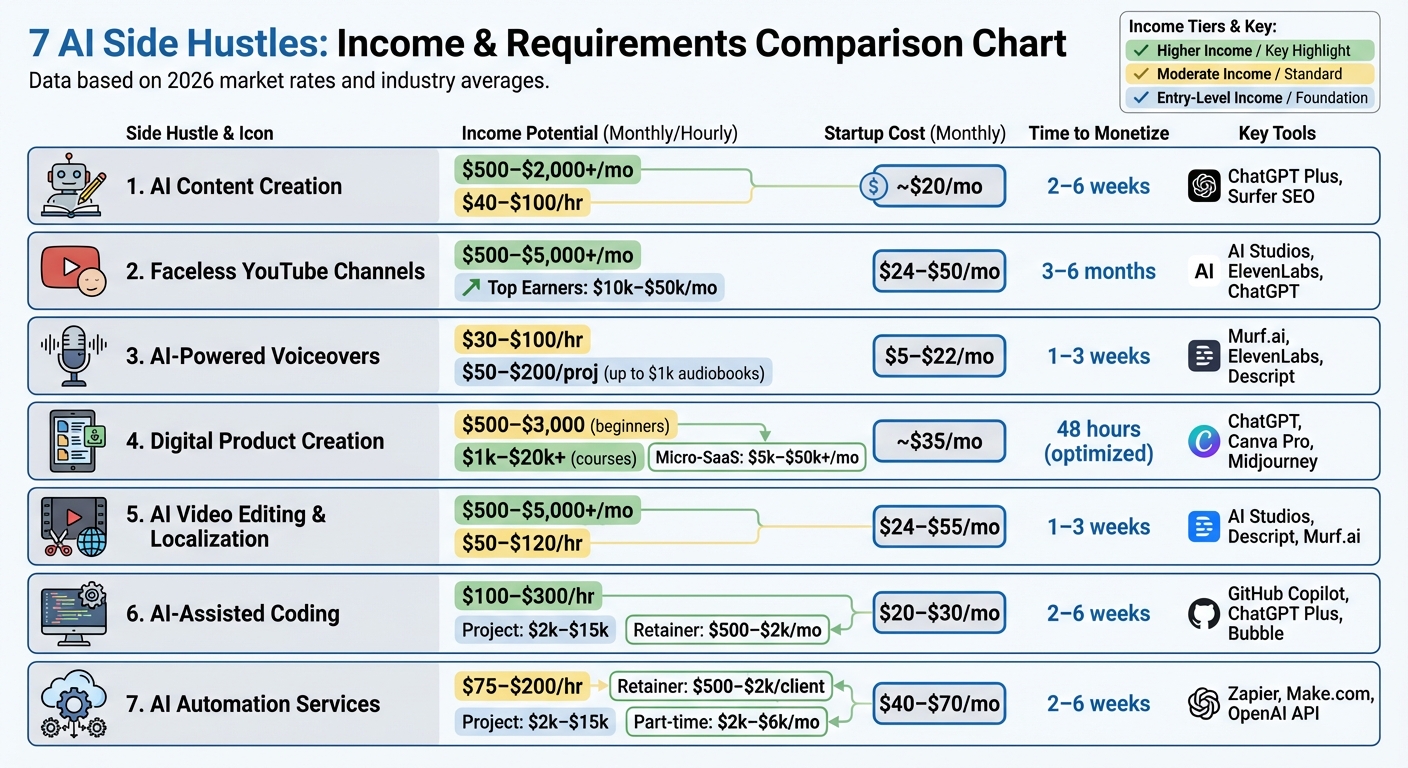
7 AI Side Hustles Income Comparison 2026
7 Best AI Side Hustles To Start From $0 In 2026
sbb-itb-d544328
1. AI Content Creation
AI content creation has become a popular and accessible way to earn extra income in 2026. This involves crafting various types of content, such as blog posts, email campaigns, social media schedules, and product descriptions, with AI tools handling the initial drafts. The copywriting industry itself is thriving, valued at $27.96 billion in 2025 and expected to grow to $42.83 billion by 2030.
The process thrives on a human-in-the-loop model, where AI quickly generates drafts while you step in to refine them – adding a personal touch, ensuring accuracy, and aligning with the brand’s voice. This approach not only speeds up production but also ensures the quality clients expect. Writers who combine AI tools with their skills earn, on average, 22% more per hour compared to traditional freelancers.
Some of the most profitable niches in this space include B2B SaaS content, real estate marketing, and e-commerce product descriptions, as these directly impact revenue through well-targeted copy. Jeremiah Curvers, Co-founder and CEO of Polysleep, highlights the ease of leveraging AI for SEO:
"There are so many [SEO] apps, tools, and resources. You don’t need to be an expert, especially now with the advent of so many AI tools. It’s very easy to build a keyword list based on competitiveness."
This model not only simplifies content creation but also offers a reliable way to generate consistent income.
Income Potential
The financial rewards of AI content creation are clear. As a side hustle, it can bring in $500 to $2,000+ per month, with hourly rates typically ranging from $40 to $100. Specialized projects, such as technical whitepapers or SEO-focused content, can command even higher rates – upwards of $150 per hour. For predictable income, you could offer monthly retainer packages, such as charging $500 per month for four blog posts and social media management.
What makes this side hustle even more appealing is the low startup cost, which we’ll explore next.
Ease of Starting and Required Tools
Getting started with AI content creation is simple and budget-friendly. At a minimum, you’ll need ChatGPT Plus or Claude Pro (around $20/month), an SEO tool like Surfer SEO ($59/month), and 3–5 polished sample pieces to showcase your work. You can use AI to draft these samples, then refine them manually to highlight your editing skills and personal touch. Once ready, you can pitch your services on platforms like Upwork or reach out to potential clients directly.
For those looking to expand their toolkit, optional tools like Jasper AI (ideal for marketing copy, $39–$125/month) can help maintain a consistent tone, while Grammarly ensures top-notch quality control.
Scalability
AI tools make scaling your workload far easier. By reducing the time needed to create content, you can handle more clients without working additional hours. Once you hit $2,000 or more in monthly earnings, you might consider transitioning from freelancing to running a small agency. This could involve hiring writers and editors to handle overflow work while you focus on managing clients.
To maintain quality as you grow, build a library of refined AI prompts and encourage clients to move to monthly retainer agreements. This creates a steady, recurring revenue stream and positions you for long-term success in this booming field.
2. Faceless YouTube Channels
Faceless YouTube channels offer a unique way to build a thriving content business without stepping in front of the camera. Instead, you can rely on AI-generated voiceovers, digital avatars, and automated visuals to craft engaging videos. This approach works well because modern AI tools can handle most production tasks – like scripting, editing, and even visuals – making it possible to produce 2–3 videos a week with ease.
The key to success here is choosing a micro-niche. Instead of broad topics, focus on something specific, such as "AI-powered productivity for remote workers." This strategy helps attract a loyal audience and premium advertisers. For instance, in March 2025, Alijee Writes launched a faceless channel centered on AI productivity for remote workers. By blending AI automation with personal editing touches, the channel gained 1,200 subscribers by April 30, 2025. Revenue jumped from $487 in the second month to $3,401 in the fourth month, thanks to a digital product bundle.
To get started, you can use tools like ChatGPT or Claude to draft scripts. Just make sure to add at least 30% of personal storytelling to avoid YouTube penalties. For voiceovers, platforms like ElevenLabs ($5–$22/month) or Murf.ai are excellent options. Pair these with video creation tools like AI Studios ($24/month) or Invideo AI. To stay ahead of trends, vidIQ can help you identify promising topics before they become oversaturated.
Income Potential
Once monetized, faceless YouTube channels can bring in anywhere from $500 to over $5,000 per month, with top creators earning between $10,000 and $50,000. Sponsorships alone can generate $50,000 to $100,000+ annually. Revenue streams include YouTube’s Partner Program, which pays out 55% of ad revenue, affiliate marketing, and brand sponsorships. To qualify for ad monetization, you’ll need 1,000 subscribers and 4,000 watch hours. It typically takes 3–6 months of consistent uploads to reach this milestone.
Required Tools and Platforms
Here’s a handy toolkit to get started:
- Scriptwriting: ChatGPT or Claude Pro ($20/month)
- Video Creation: AI Studios ($24/month) or Synthesia
- Voiceovers: ElevenLabs ($5–$22/month)
- Editing and Captions: CapCut or Descript ($12–$16/month)
- Thumbnails: Canva AI or Midjourney
- Audio Enhancements: Adobe Podcast AI for studio-quality sound
High-contrast thumbnails featuring emotional expressions can dramatically boost click-through rates, so don’t overlook this step.
Scalability
Scaling faceless YouTube channels is straightforward with AI tools. Once you’ve nailed your production workflow, you can repurpose long-form videos into vertical clips for TikTok and Instagram Reels using 9:16 templates, creating additional revenue streams. Another effective strategy is the Shorts-to-Long-form funnel – producing 3–4 YouTube Shorts for every full-length video – to drive rapid subscriber growth.
You can also expand globally by using AI localization tools to translate and dub your videos into over 150 languages, unlocking new audience segments. Beyond ad revenue, successful channels are exploring extra monetization methods like YouTube Shopping (tagging affiliate products), selling custom prompt libraries, and offering digital templates tailored to their audience.
Next, we’ll dive into how AI voiceovers can open up even more income-generating opportunities.
3. AI-Powered Freelance Voiceovers
AI voiceover technology allows you to create high-quality audio without needing pricey equipment or a professional recording studio. Platforms like Murf.ai and ElevenLabs make it possible to produce polished narration for advertisements, explainer videos, and YouTube content in just minutes. The real earning potential, however, lies in specialized services like video localization and dubbing for global brands, which are in high demand.
On freelance platforms like Upwork or Fiverr, standard voiceover projects typically pay between $50 and $200. Audiobook narration gigs can be even more lucrative, with payouts reaching up to $1,000 per project. Meanwhile, video localization services often command fees ranging from $100 to $500. Another high-paying niche is AI spokesperson videos, where digital avatars deliver scripted content, averaging $110 per day.
Income Potential
Freelancers offering AI voiceover services can expect to earn $30 to $100 per hour, with short-form projects like ads or social media videos typically paying $50 to $200 per project. For high-value areas such as e-learning narration or audiobooks, rates are often billed per completed hour, leading to significantly higher earnings. In technical niches, experienced freelancers may surpass $50 per hour. Thanks to AI tools, production times are drastically reduced – what once required days can now be completed in just hours. This efficiency allows freelancers to take on more clients and maximize their income.
Ease of Starting
Getting started in AI voiceovers is straightforward and doesn’t require prior experience or expensive gear. Simply choose an AI platform like Murf.ai or ElevenLabs, create sample voiceovers across different categories (e.g., ads, e-learning, and explainer videos), and set up profiles on freelance sites like Upwork or Fiverr. Highlight your "quick turnaround" and "professional AI audio" capabilities to stand out.
As Vishnu Ramesh from Murf AI explains:
"AI isn’t just reshaping industries – it’s creating brand-new income streams for everyday people".
Transparency is key – always inform clients about your use of AI tools to maintain trust and comply with platform policies.
Required Tools and Platforms
The basic tools for AI voiceover work include a laptop, internet connection, and access to an AI voice platform. Here are some popular options:
- Murf.ai: Offers studio-grade voices in various accents and languages.
- ElevenLabs: Specializes in high-quality voice cloning, with plans costing $5 to $22 per month.
- Descript: Provides AI-powered audio editing for around $12–$16 per month.
- ChatGPT or Claude Pro: Useful for drafting narration scripts, priced at $20 per month.
To find clients, consider freelance platforms such as Upwork, Fiverr, and PeoplePerHour.
Scalability
One way to scale your AI voiceover business is by creating reusable "Voice Packs" or interactive voice response (IVR) prompts, which can generate ongoing income. Start by building your portfolio with short-form projects like TikTok narrations, YouTube Shorts, or Instagram Reels. Once you’ve established yourself, branch out into more lucrative areas such as e-learning modules and audiobooks.
Offering multilingual dubbing services can attract international clients and justify higher rates. As you refine your workflow, consider transitioning to passive income streams by selling pre-recorded voice packs or developing custom voice agents for local businesses using AI APIs. You can also bundle voiceovers with related services like video editing or social media management to create comprehensive packages that command premium fees. This approach not only increases your earnings but also mirrors trends seen across other AI-driven side hustles.
4. Digital Product Creation
AI has completely transformed how digital products are created and sold. With tools like ChatGPT and Canva, you can produce and sell items such as digital planners, online courses, e-books, printables, and micro-SaaS tools. The beauty of this business model is its simplicity: create a product once, then sell it repeatedly, often enjoying profit margins that exceed 90%. Automation and scalability make this a powerful way to generate consistent income.
Some of the most popular products in this space include digital planners and templates, typically priced between $10 and $40, and online courses, which range from $50 to $200. There’s also growing demand for AI prompt libraries tailored to industries like marketing or law, priced at $20–$60 per pack. For those aiming higher, micro-SaaS products – small, AI-powered tools that solve specific workflow challenges – can bring in anywhere from $5,000 to $50,000+ per month.
Take Marco Cabrera as an example: in 2024, he used ChatGPT and Canva to create a Fitness Meal Plan Guide, earning $5,700 in just 30 days by selling it on Gumroad. Similarly, educator Vasco Cavalheiro has made nearly $2 million over eight years by selling software development courses.
Income Potential
Digital products stand out as one of the most lucrative opportunities in the AI side hustle world. For instance, beginners selling printables or templates on Etsy can make $500–$3,000 a month. Those creating and selling online courses often see monthly earnings ranging from $1,000 to $20,000 or more once they’ve built an audience. Other niches, like self-publishing children’s books on Amazon KDP, can yield $1,000–$10,000 in passive income each month. Meanwhile, successful micro-SaaS ventures can surpass $50,000 in monthly revenue.
AI tools have significantly cut down the time required for production. What used to take months can now be accomplished in days, with an estimated 80% reduction in creation time. For example, you could develop 50+ variations of a product, such as planner designs or art prints, in minutes and sell them as bundled "Mega Packs" priced between $37 and $67.
Ease of Starting
You don’t need technical expertise to get started. Begin by identifying a niche using tools like Google Trends, then use ChatGPT for content creation and Canva for design. Platforms like Etsy, Gumroad, or Amazon KDP make it easy to list your products and start selling. Many creators report making their first sales within 48 hours of launching a well-optimized listing. This side hustle requires minimal upfront investment, making it accessible to almost anyone.
Ann Koppuzha, founder of Powerhouse Legal Strategy, shared her experience:
"I use AI tools, like ChatGPT, to craft legal contracts… I largely provide the input and have ChatGPT polish my input, then sell my AI-drafted contract templates on my online shop… So far, I’ve made a few thousand dollars selling these contract templates."
The key to success is adding a personal touch to AI-generated products. Instead of selling raw AI output, enhance your work with unique fonts, branding, or specialized insights to maintain high-quality standards.
Required Tools and Platforms
Getting started with digital product creation is affordable. Here’s a breakdown of some essential tools:
- ChatGPT Plus: $20/month for content generation.
- Canva Pro: Around $15/month for design needs.
- Midjourney: $10–$60/month for creating AI-generated art.
- Descript: $12–$16/month for video and audio editing.
When it comes to selling, platforms charge varying fees. Gumroad takes about 10%, Etsy charges approximately 16.1% in combined fees, and Stripe processes payments at 2.9% + $0.30 per transaction. For beginners, Etsy – with its 91.5 million active buyers – is an excellent starting point. As you scale, moving to platforms like Shopify or WordPress can give you greater control over your audience.
These tools and platforms not only simplify the creation process but also make scaling your business much easier.
Scalability
Like other AI-driven ventures, digital product creation is highly scalable. Start small by creating 1–5 core products using tools like ChatGPT, Midjourney, and Canva. Once you see demand, batch-produce 50+ variations and package them into bundles to boost the average order value. Automation tools like Zapier and Make can handle sales workflows, while AI chatbots can manage customer support, paving the way for passive income.
Some high-demand niches for 2026 include ADHD planners, AI-generated fantasy art prints, hyperlinked Notion-style planners, and branding kits for small businesses. Top sellers in these categories can earn $15,000+ per month with as few as 20 high-quality listings. Even beginners have scaled to $3,000 in monthly revenue within just 30 days, often with no upfront costs. The digital planners market alone was valued at $3.58 billion in 2025 and is projected to grow to $7.05 billion by 2033, highlighting the immense potential in this space.
5. AI Video Editing and Localization
Video content is booming across every platform, and AI technology has made it easier than ever to create professional-quality videos – no camera needed. Tools like AI Studios and Runway allow you to produce explainer videos, corporate training materials, and marketing ads in just minutes. These tools use advanced avatars and automated video creation to streamline the process. But the real game-changer? Localization. This involves translating and dubbing videos into over 150 languages, enabling brands to connect with audiences worldwide. As AI Studios aptly puts it:
"The next wave of creators won’t film – they’ll generate."
AI tools empower freelancers to compete with high-end production studios. For example, a standard 1-minute explainer video might earn $50–$200, but adding multilingual localization can push that same project to $150–$500. One freelancer reportedly earned $2,500 by localizing a corporate training video into 20 languages, while another generated an extra $3,000 monthly by offering fitness tips in 10 languages. This shift is opening the door to higher earnings through localization services.
Income Potential
For beginners, basic video projects like product promos or social media repurposing can bring in $500–$2,000 per month. As your skills grow and you expand into localization services, monthly earnings can climb to $2,000–$5,000 or more. Freelancers offering AI video editing typically charge $50 to $120 per hour, while those running faceless YouTube channels using AI avatars and voiceovers can earn between $500 and $6,000+ per month through ad revenue and sponsorships.
Take the example of the "AI Explained" YouTube channel, launched in 2025. Using ChatGPT for scriptwriting and AI Studios for video production, the creator produced 30 videos in just three months, gained 120,000 subscribers, and earned $6,200 per month from ads and sponsorships. The key advantage here is speed – tasks that once took days can now be completed in hours, allowing you to juggle multiple clients and projects with ease.
Ease of Starting
Getting started in AI video editing and localization is surprisingly straightforward. Like other AI side hustles, it requires minimal investment and no advanced technical skills. Most AI video tools in 2026 are browser-based, meaning you won’t need expensive hardware or coding expertise. A basic understanding of storytelling and scriptwriting is helpful, but tools like ChatGPT can handle much of the heavy lifting.
To begin, focus on high-demand niches like real estate listings, e-commerce product demos, or corporate training videos. Platforms like AI Studios offer over 7,000 templates to simplify the process, and tools like Synthesia let you create avatar-based videos with ease. Many freelancers land their first project within 1 to 3 weeks of starting. Build a small portfolio with five diverse projects and list your services on platforms like Fiverr or Upwork. Upselling is a key strategy – offer a base video in English, then charge extra for multilingual versions to significantly increase your earnings.
Required Tools and Platforms
| Tool Category | Key Platforms | Monthly Cost |
|---|---|---|
| Video Generation | AI Studios, Synthesia, HeyGen | $24–$55 |
| Editing & Repurposing | Descript, CapCut, Runway | $12–$16 |
| Localization & Dubbing | Murf.ai, ElevenLabs | Varies (free to test) |
| Scripting | ChatGPT Plus | $20 |
AI Studios offers a Personal Plan for $24 per month and a Team Plan for $55 per month. Descript costs around $12–$16 per month for editing and voice cloning. Many platforms, like Murf.ai, provide free versions for testing before committing to paid plans. Since most of these tools are browser-based, there’s no need for high-end computers or pricey software licenses.
Scalability
Speed and batch production are essential for scaling your AI video editing business. Start with freelance gigs on platforms like Upwork, and as you gain experience, transition to an agency model where you manage multiple clients using automation tools like Zapier. Batch production is key: generate visuals, voiceovers, and music in bulk to maximize efficiency.
High-value niches like corporate training or SaaS companies, which require consistent video content, offer the best opportunities for growth. As your business expands, consider hiring automation specialists to handle routine tasks while you focus on client acquisition and strategy. Freelancers with AI expertise earn up to 22% more per hour compared to traditional roles, and the demand for AI-related jobs has grown by 300% since 2023. The future looks promising for those ready to embrace these tools and opportunities.
6. AI-Assisted Coding and App Development
Thanks to advancements in AI, coding and app development are no longer reserved for those with technical degrees. Tools like GitHub Copilot, ChatGPT, and Claude Code make it possible for anyone to dive into software creation and start earning in just a few weeks. These AI assistants take care of the technical grunt work – generating boilerplate code, debugging, and structuring website architecture – so you can focus on solving real-world problems businesses face today. And the best part? What used to cost thousands of dollars now runs at about $20 per month in API credits.
AI integration services are a particularly lucrative area. Many businesses need help connecting AI APIs, such as OpenAI or Claude, to their existing systems like CRMs or websites. This specialized work can earn you $100 to $300 per hour, with full automation projects ranging from $2,000 to $15,000. Maintenance fees alone can bring in an additional $500 to $2,000 per month. Another promising path is creating Micro-SaaS tools – small, niche software solutions that address specific problems and generate recurring revenue. These tools can bring in anywhere from $5,000 to over $50,000 per month in passive income.
Income Potential
The earning potential in this space is impressive, even with minimal upfront investment. For example, AI and machine learning engineers in the U.S. earn an average salary of $170,768 annually. Freelancers specializing in AI integration and API development charge between $100 and $300 per hour, while custom website projects typically bring in $2,500 to $5,000. If you have expertise in fine-tuning AI models, you can command rates of $150 to $400 per hour.
The real financial growth happens when you transition from hourly work to subscription-based products. Beginners can expect to land their first paid project within 2 to 6 weeks by focusing on niches like WordPress AI integration or basic automation tools.
Ease of Starting
Getting started in AI-assisted coding has never been more accessible. Platforms like Bubble and Softr allow you to build Minimum Viable Products (MVPs) quickly when paired with OpenAI or Claude APIs. To gain traction, create five sample projects to demonstrate your skills. Many businesses are actively seeking help with integrating AI APIs into their existing systems, making this a great entry point.
Key skills to develop include prompt engineering (writing precise instructions for AI), workflow automation, and a basic understanding of no-code platforms. You don’t need to be an expert in JavaScript or Python – AI tools can handle the technical aspects while you focus on strategy and user experience. The emphasis has shifted from writing code manually to effectively leveraging AI tools to create, debug, and integrate software.
Required Tools and Platforms
| Tool Category | Recommended Platforms | Monthly Cost |
|---|---|---|
| Coding Assistants | GitHub Copilot, ChatGPT Plus, Claude Pro | $20–$30 |
| No-Code App Builders | Bubble, Softr, Glide | Free–$30 |
| Web Development | WordPress, Framer, CodeWP | Free–$20 |
| Deployment & Hosting | Vercel, Replit | Free–$20 |
| Automation/APIs | Make.com, LangChain, OpenAI API | Free–$16 |
Most of these platforms offer free tiers, allowing you to test the waters before committing to a paid plan. For instance, ChatGPT Plus and Claude Pro cost around $20 per month for coding assistance, while Make.com offers plans ranging from free to approximately $16 per month for workflow automation. GitHub Copilot remains a go-to tool for AI-assisted coding, streamlining the development process and freeing up your time for more profitable tasks.
Scalability
Scaling your efforts is all about turning common coding projects into subscription-based Micro-SaaS tools. Another strategy is creating custom AI agents tailored for local businesses, like dentists, plumbers, or real estate agents. These agents can automate repetitive tasks such as appointment scheduling or lead qualification, with project fees ranging from $2,000 to $15,000. Subscription models complement this approach, offering a steady revenue stream alongside one-off projects.
The potential here is immense. The AI market is expected to hit $1.77 trillion by 2032, growing at an annual rate of 29.2%. Job postings requiring generative AI skills have surged, jumping from just 55 in January 2021 to nearly 10,000 by May 2025. Wages in industries heavily influenced by AI are also climbing at twice the rate of those in less AI-driven sectors. The opportunities for growth and income are only expanding.
7. AI Automation Services
AI automation services are shaping up to be a lucrative opportunity in 2026. With 75% of small businesses already using or exploring AI for automating repetitive tasks, there’s a clear demand. However, many companies struggle with implementing these tools effectively, leaving a gap you can fill. This side hustle involves connecting no-code platforms like Zapier or Make.com with AI APIs such as OpenAI or Claude. Tasks you can automate include lead capture from website forms, drafting email responses, setting up customer service chatbots, scheduling social media posts, and managing sales inboxes. As one expert put it:
"Most businesses don’t know how to effectively use AI tools. You can be the bridge." – SideQuestHustle
Income Potential
The earning potential here is impressive. You can charge between $75 and $200 per hour, and specialized automation projects can bring in $2,000–$15,000. Beyond one-time projects, offering maintenance and optimization services on a monthly retainer could add $500–$2,000 per client. Even part-time practitioners working 15–20 hours a week can earn $2,000–$6,000 monthly. On average, professionals in this field can earn about 28% more annually – an $18,000 premium compared to similar roles.
Ease of Starting
Starting out in AI automation is surprisingly straightforward. Many beginners secure their first paid project within 2–6 weeks. Here’s a simple approach: spend a week learning 2–3 basic automations, such as lead capture or automated email responses. Build sample workflows tailored to a specific niche, and then pitch local businesses by offering a workflow audit. The best part? You don’t need a computer science degree. Success comes from effectively using existing tools, not building them from scratch. Starting with simple automations that deliver immediate ROI is a smart way to gain traction.
Required Tools and Platforms
| Category | Recommended Tools | Monthly Cost |
|---|---|---|
| Workflow Automation | Zapier, Make.com, n8n | $0–$16 |
| AI APIs | OpenAI API, Claude API | $20–$30 |
| Chatbot Builders | Botpress, Voiceflow, ManyChat | $0–$25 |
| Data Storage | Airtable, Google Sheets | $0–$10 |
Most of these platforms offer free tiers, so you can test them out before committing. The basic monthly cost to get started is around $40–$70. With these affordable tools, you can start small and scale your services as you gain experience.
Scalability
This side hustle is highly scalable because you’re not just selling your time – you’re selling systems. By productizing your services, such as offering a fixed-price package like "AI Sales Inbox Triage in Two Weeks", you can move away from hourly billing and increase your profit margins. Specialists in industries like real estate, law, or e-commerce can charge even higher rates by addressing the specific workflow challenges of these sectors. To scale further, consider building a library of reusable industry-specific prompts and workflow templates. With 70% of companies planning to increase their AI budgets in 2026 and the global AI market projected to hit $1.77 trillion by 2032, the demand for these services is only expected to grow.
Conclusion
You’ve just dived into seven AI-powered side hustles that are bringing in real income in 2026. From AI content creation and faceless YouTube channels to AI-powered voiceovers, digital product creation, video editing and localization, AI-assisted coding, and automation services, each of these opportunities offers a solid way to earn money. Many even have the potential to grow from hourly gigs into steady monthly revenue streams.
Now it’s time to figure out which path aligns best with your skills. Whether you’re a natural writer or have a knack for tech, focusing on one or two areas can help you stand out. Specialists in these niches often earn $200–$300 per hour, significantly more than generalists.
Here’s a simple 30-day plan to get started: learn the basics, create five portfolio pieces, establish your professional presence, and start pitching clients. Many beginners secure their first project within just 2–6 weeks. With this approach, you’ll have a clear roadmap to follow.
If you’re looking for extra guidance, Earn with AI Club offers step-by-step support to help you avoid common mistakes and fast-track your progress. Instead of months of trial and error, you can follow a structured, hands-on approach. With 70% of companies planning to boost their AI budgets in 2026 and the global AI market expected to reach $1.77 trillion by 2032, the demand for AI-driven skills is only growing.
The tools are available, the opportunities are real – now it’s up to you to take the first step and start earning with AI.
FAQs
What are the initial costs for starting an AI side hustle?
The startup costs for AI side hustles in 2026 can range from very low to quite substantial, depending on the type of venture you pursue. If you’re starting with beginner-friendly options like content creation or managing social media using AI tools, the financial barrier is minimal. These ventures often require just $0 to $20 per month for subscriptions or software, making them accessible to nearly everyone.
On the other hand, more advanced projects, such as building custom AI applications or models, come with a much steeper price tag. Developing a sophisticated AI app could cost anywhere from $50,000 to over $600,000, depending on its complexity. Similarly, launching a large-scale AI startup might require an investment ranging from $5,000 to over $500,000.
The key takeaway? Entry-level AI side hustles are budget-friendly, while more ambitious projects demand a significant financial commitment. Pick a venture that matches both your budget and your long-term goals.
How do I pick the best AI side hustle for my skills and interests?
To find the right AI side hustle, start by taking stock of your skills, interests, and how comfortable you are with AI tools. Think about areas where you already excel or enjoy working – like writing, design, or marketing – and consider how AI can amplify those strengths. For instance, if you’re creatively inclined, you might explore AI-driven graphic design or content creation. On the other hand, marketing professionals could use AI tools to streamline social media management or automate lead generation.
It’s equally important to look into the demand and earning potential of various AI-based side gigs. Opportunities like AI consulting, chatbot development, or creating digital products with AI can be lucrative, though they may require picking up new skills. Start with something that plays to your strengths and grow your knowledge through hands-on practice and online tutorials. This approach ensures you build a solid foundation in a niche that aligns with both your passions and market opportunities.
What are the must-have tools to start an AI-powered content creation business?
To build a thriving AI-powered content creation business in 2026, having the right tools in your arsenal is crucial. These tools can help you streamline your workflow, save time, and focus on producing high-quality content.
Start with AI-driven content creation platforms. These tools are designed to automate the generation of text, images, and videos. Whether you’re crafting blog posts, designing graphics, or producing video content, these platforms can handle much of the heavy lifting, allowing you to focus on strategy and creativity.
You’ll also want to explore automation and workflow management tools. These platforms integrate features like calendars, email systems, and content scheduling, making it easier to plan and distribute your work. Plus, they often let you automate repetitive tasks – no coding skills required.
Another essential resource is trend analysis and market research tools. These help you stay ahead of the curve by identifying trending topics and popular niches, ensuring your content remains relevant and competitive.
Lastly, invest in design and editing platforms with AI capabilities. These tools make it simple to create professional-looking graphics and videos, even if you don’t have a background in design. With AI-enhanced features, you can produce polished, visually appealing content that captures attention.
By leveraging these tools effectively, you can not only simplify your content creation process but also position your business for long-term success.


