5 AI Subscription Ideas for Passive Income
AI subscription models are reshaping how people generate passive income. With the global AI market projected to hit $42.6 billion by 2026, now is the time to tap into its potential. Here are five ideas to get started:
- AI Expert Clone: Turn your expertise into a 24/7 AI assistant, offering personalized coaching or advice. Pricing tiers can range from $29 to $199/month.
- AI-Curated Newsletters: Automate research and summaries in niche topics. Even a small newsletter can generate $3,000–$5,000/month through subscriptions, sponsorships, and affiliate marketing.
- AI-Generated Design Libraries: Offer digital assets like patterns or icons via memberships. Creators have reported earnings of $2,600–$32,000/month.
- AI Learning Roadmaps: Provide tailored educational plans using AI tools. Subscriptions can earn $10–$199/month, with potential for $25,000/month from 1,000 subscribers.
- AI Financial Tools: Build apps that audit finances or optimize expenses. Subscription fees range from $5–$20/month.
AI’s ability to automate tasks means you can set up these models with minimal effort and scale quickly. Start small, test your idea, and let AI handle the heavy lifting.
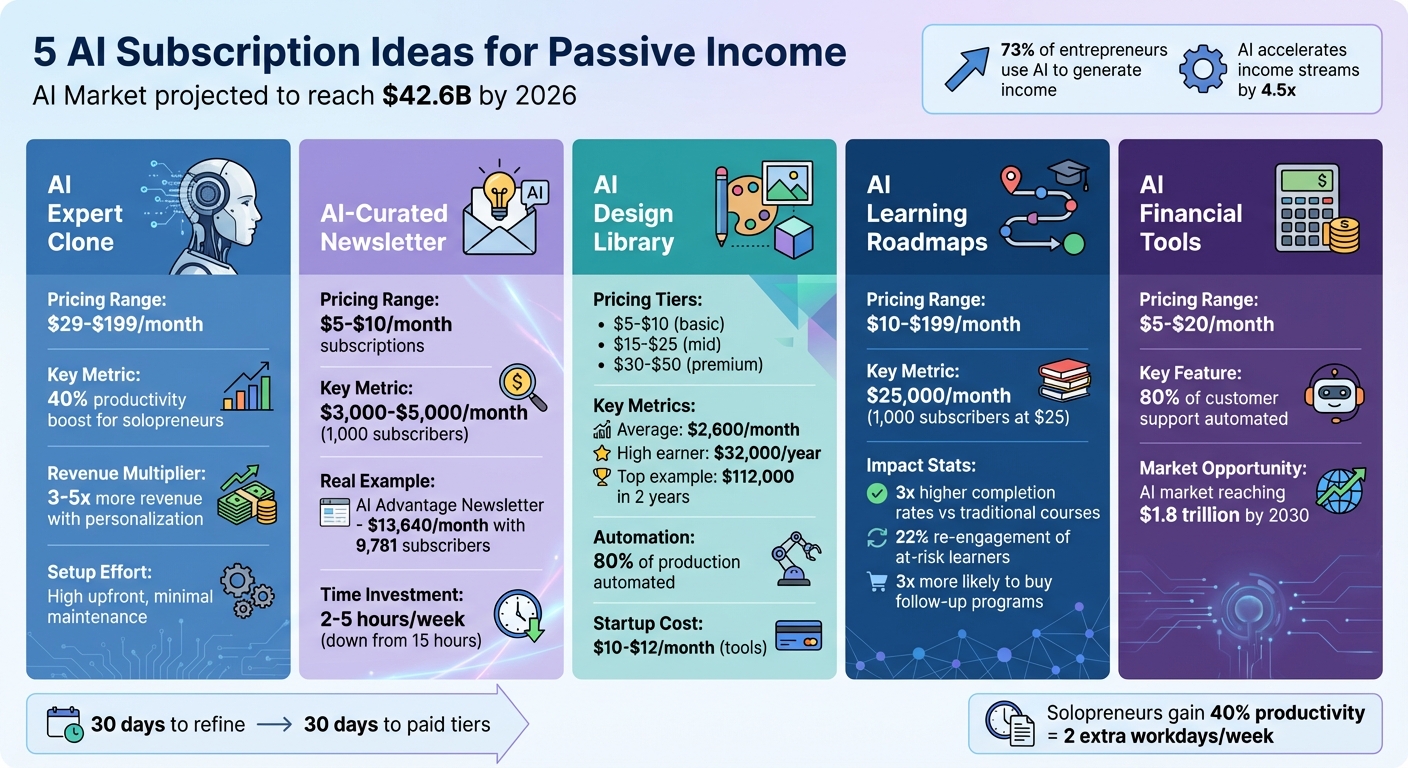
5 AI Subscription Business Models: Revenue Potential and Pricing Comparison
1. Personalization
AI Expert Clone Subscription
Imagine offering your audience round-the-clock access to an AI version of yourself – your expertise, methods, and insights – all packaged into a personalized AI assistant. This "expert clone" could provide tailored coaching and advice without requiring your constant involvement, making it an excellent fit for those looking to scale their income without sacrificing personal time.
This idea taps into the power of scalability. Coaches and consultants can monetize their knowledge by delivering what feels like one-on-one support to an unlimited number of subscribers – all at the same time.
The data supports this approach: newsletters that use advanced segmentation to deliver personalized content generate 3 to 5 times more revenue per subscriber compared to generic email blasts. Solopreneurs who integrate AI personalization into their workflows report productivity boosts of up to 40%. This frees up their time to focus on strategic, high-impact tasks while leaving routine, personalized communications to the AI.
Pricing for these AI subscriptions is usually tiered. Entry-level access might start at $29/month, while more advanced plans – offering in-depth strategy and analysis – can range from $49 to $199/month. By training your AI on proprietary data, you can deliver a level of value that subscribers won’t find anywhere else.
Although setting up this digital clone takes some upfront effort, it eventually requires minimal supervision. Once it’s up and running, your AI assistant can continuously generate income, showcasing how a single setup can lead to ongoing financial rewards.
sbb-itb-d544328
2. Content Curation
AI-Powered Niche Newsletter
An AI-curated newsletter takes care of the heavy lifting – researching, summarizing, and delivering content – so you can focus on adding your personal insights. Tools like ChatGPT or Claude can scan multiple sources, identify trending topics in your niche, and draft concise summaries. This can cut your weekly workload down to just 2–5 hours . Essentially, these tools act like personalized assistants, helping you scale both your content output and revenue.
Take the AI Advantage Newsletter as an example. From January 2024 to January 2025, it grew from zero to 9,781 subscribers and generated $13,640 in monthly revenue. This success came from a mix of paid subscriptions, sponsorships, affiliate marketing, and digital products. Initially requiring 15 hours of work per week, automation reduced the time commitment to just 5 hours.
The secret to making this model profitable? Focus on niches with "information asymmetry" – areas where curated, hard-to-find insights give readers a competitive edge. Think of topics like financial trends, AI tool updates, or professional development strategies. Even a small newsletter with just 1,000 subscribers can earn between $3,000 and $5,000 per month. This income typically comes from a mix of paid subscriptions (priced at $5–$10 per month), sponsorships ($10–$50 per 1,000 opens), and affiliate commissions . It’s a clear example of how AI can help create a steady income stream with minimal ongoing effort.
"AI is a productivity multiplier – but your unique voice, curation, and editorial judgment are the durable advantages. Use AI to accelerate, not to replace your editorial decision-making." – TrendVibz
To test your idea, start with a landing page. Let AI handle about 60% of the work – researching and drafting – while you focus on the remaining 40%: fact-checking, adding commentary, and preserving your personal style.
3. Creative Assets
AI-Generated Design Subscription Library
Imagine building a digital library packed with AI-generated creative assets – think patterns, clip art, icons, or even photography – and offering access through monthly memberships. Tools like Midjourney and DALL-E 3 make it easy to produce high-quality visuals with just a few text prompts. Platforms like Gumroad or Creative Fabrica can handle the logistics, managing recurring payments and delivering files automatically. This approach takes advantage of AI’s ability to produce visual content efficiently, creating a steady stream of income.
This model works similarly to personalized subscriptions or niche newsletters, leveraging AI’s scalability to generate consistent revenue. For instance, some sellers on Etsy have reported impressive earnings – successful pattern creators average about $2,600 per month, while others selling AI-generated clip art have made up to $32,000 annually. One standout example is an Etsy seller who earned over $112,000 in just two years by offering coloring worksheets. The secret? Focus on niche-specific bundles. By targeting specialized themes or creating curated design collections, you can carve out a space in competitive markets.
Automation plays a huge role in this process, allowing you to focus on curation and quality control. By batch-generating assets, you can automate up to 80% of production. Tools like Zapier or Make.com can connect your AI design software to your delivery platform, creating a seamless pipeline. For example, dedicating one session to produce a month’s worth of assets ensures consistent delivery to your subscribers.
Once production is under control, pricing becomes the next key step. A tiered pricing model works well here:
- Entry-level tier: $5–$10 per month for basic assets.
- Mid-tier: $15–$25 for more specialized templates.
- Premium tier: $30–$50 for exclusive bundles or perks like community access.
Even at the lowest tier, 1,000 subscribers could bring in $5,000 to $10,000 in monthly recurring revenue. And the startup costs? They’re surprisingly low. Subscriptions to tools like Midjourney cost around $10 per month, while Canva Pro is about $12 per month. It’s a straightforward, scalable way to turn creativity into a reliable income stream.
4. Education
AI-Powered Personalized Learning Roadmaps
Traditional courses often bombard learners with one-size-fits-all content, leaving many overwhelmed and disengaged. AI changes the game by crafting personalized learning paths. These paths include tailored roadmaps, curated resources, and adaptive content that adjust to individual needs – far surpassing the effectiveness of traditional methods.
For example, AI tutors have been shown to triple course completion rates compared to traditional self-paced courses, where only 6–8% of participants typically finish. Additionally, AI-driven engagement strategies can bring back about 22% of learners who are on the verge of dropping out. And here’s the kicker: students who complete their courses are three times more likely to invest in follow-up programs.
To create these personalized experiences, you can leverage tools like ChatGPT or Claude for generating custom learning plans, Perplexity AI for sourcing up-to-date resources, and platforms such as Podia or Beehiiv to manage subscriptions and deliver content automatically. Start by collecting subscriber data through a simple form, then feed it into your AI system to produce 4–8 week personalized roadmaps. This approach works particularly well in high-demand areas like career transitions (e.g., "AI for Marketers") or professional certification prep, where customized guidance can make a huge impact.
When it comes to pricing, a tiered model works best. Offer basic plans for $10–$50 per month, while premium tiers – complete with personalized coaching – can range from $49 to $199 per month. You could also offer one-time custom roadmaps priced at $75–$150, bundling them with ongoing subscriptions for added value. To put this into perspective, just 1,000 subscribers at $25 per month would bring in $25,000 in recurring monthly revenue. And since startup costs are minimal, you can focus on delivering high-quality content while AI handles the heavy lifting.
5. Finance
AI-Powered Financial Auditor & Expense Optimizer
It’s easy to lose track of money through unnoticed subscriptions or miscategorized expenses. An AI-powered financial auditor can tackle this issue by scanning bank statements, flagging unnecessary spending, categorizing expenses for tax purposes, and even offering personalized savings tips.
This concept thrives on automation. You can create streamlined Micro-SaaS agents using no-code platforms like Bubble or Glide. Combine these tools with automation platforms such as Zapier, Make, or N8N to integrate AI APIs with user data, ensuring smooth and efficient management.
The potential here is massive: 73% of entrepreneurs already leverage AI to generate income, and AI can accelerate the creation of income streams by up to 4.5 times. As one expert explains:
"AI is the ultimate catalyst for building genuine AI passive income because it attacks the immense upfront effort and cost".
Micro-SaaS financial tools often charge a subscription fee ranging from $5 to $20 per month. To find your niche, look for common complaints about banking apps on forums. From there, launch a simple MVP (minimum viable product) on platforms like Product Hunt or Gumroad. You can even automate customer support using ChatGPT-powered chatbots, which can handle up to 80% of inquiries.
This type of financial tool not only solves a common problem but also creates a low-maintenance income stream. With the global AI market expected to hit $1.8 trillion by 2030, and solopreneurs using AI boosting their productivity by as much as 40%, the opportunity is hard to ignore. Low startup costs and 24/7 functionality make this an attractive option for anyone looking to earn passive income while addressing real financial challenges.
3 Passive Income Business Ideas Using AI | Live Setup Walk Through (2026)
Conclusion
AI-powered subscription services present a straightforward way to create passive income streams. Here’s a standout statistic: 73% of entrepreneurs are already leveraging AI to generate income, and this technology speeds up the process by 4.5 times compared to older methods. With the AI market expected to hit $1.8 trillion by 2030, there’s no shortage of opportunities for those ready to dive in.
One of AI’s biggest advantages is how it breaks down traditional barriers. You don’t need to know how to code, have a design degree, or invest a fortune upfront. AI tools take care of the heavy lifting, leaving you to focus on strategy and ensuring quality. This means anyone, regardless of technical expertise, can scale their efforts quickly and effectively.
To get started, keep it simple: pick one niche and one way to monetize. Whether it’s personalized content, curated newsletters, creative assets, educational materials, or financial tools, the key is to test your idea fast and automate smartly. Use the first 30 days to refine your concept and build an audience. By the next 30 days, you can introduce paid tiers. Research shows that solopreneurs using AI can boost their productivity by up to 40%, potentially freeing up almost two extra workdays per week.
The tools to make this happen are already available. Platforms like Beehiiv, Gumroad, and Zapier allow you to create fully automated systems without needing technical expertise. Once set up, your AI-powered subscription business can run 24/7, generating income even while you sleep. For step-by-step guidance, check out resources like Earn with AI Club to help you build your system.
The real question isn’t whether AI subscription services can create passive income – it’s whether you’re ready to take the first step today.
FAQs
How can I choose the best AI subscription model based on my skills?
Choosing the right AI subscription model begins with understanding your strengths and interests. What are you naturally good at? Whether it’s content creation, marketing, or technical skills, think about how you can use those talents to generate income. For instance, if you’re well-versed in a specific niche, AI tools can help you create digital products like eBooks, templates, or online courses – products that can sell continuously with little intervention.
If you’d rather take a more passive route, look into subscription-based services or AI-powered platforms that generate recurring income with minimal effort. Also, consider how comfortable you are with marketing and automation. Options like AI-driven affiliate marketing or monetized newsletters can be excellent choices if you want to build on your existing skills while keeping manual work low.
The ideal model should match your current abilities and long-term aspirations while offering opportunities for growth and automation. Start with a small-scale approach, try different strategies, and fine-tune your methods as you gain more experience.
What are the first steps to start an AI-powered subscription service?
To kick off an AI-powered subscription service, start by pinpointing a specific niche or problem you know well – something that can be addressed effectively with AI. This might include offering automated tools, generating content, or providing services that continually deliver value to your subscribers.
From there, select AI tools that fit the needs of your service. These could be platforms designed for automating tasks, creating content, or handling customer interactions. After shaping your product or service, establish a subscription model that’s both scalable and simple to manage. Don’t forget to implement a reliable billing system and develop a solid marketing strategy to draw in and keep subscribers. Wherever possible, automate parts of the process to save time and streamline operations.
How can AI help me scale my passive income streams more effectively?
AI tools can change the game when it comes to scaling passive income by taking over repetitive tasks like content creation, marketing, and customer engagement. Imagine this: AI can help you churn out digital products like eBooks, templates, or online courses with very little effort. Once created, these products can be sold over and over again without requiring much ongoing work.
On top of that, AI can handle automation for things like subscription services, newsletters, or even faceless YouTube channels. It can take care of tasks such as delivering content, interacting with your audience, editing videos, and managing monetization strategies. This means you can grow your audience and boost your revenue without piling on extra work. Essentially, AI works like a digital assistant, helping you set up scalable and automated income streams while keeping your workload light and efficiency high.